

In some respects, Steven High’s The Left in Power may not seem like a conventional historical account of a government or its era – but this works to its advantage. Though doubtless useful to a range of academics, the book is particularly informative for those seeking to rebuild progressive political parties or the labour movement in Canada today. While the economic challenges Canada currently faces – trade war and tariffs, disrupted supply chains, and an end to the “special relationship” with the United States – are not identical to those that preceded the unexpected 1990 rise to power of the Ontario New Democratic Party (ONDP) under the leadership of Bob Rae, the party’s successes and failures are worth reconsidering. An avowedly progressive, social-democratic party with a solid foundation rooted in organized labour, the ONDP ascended to power just as Ontario descended into one of the worst economic and industrial crises in the province’s history.
The Left in Power Between the Lines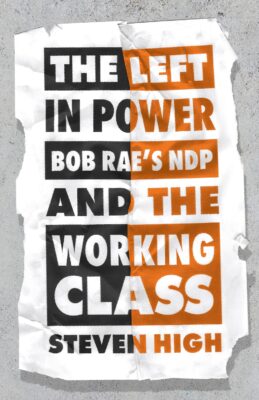
Bob Rae’s NDP and the Working Class
Steven High
$39.95
paper
486pp
9781771136679
High details the Rae government’s initial “firefighting” efforts during a period of accelerated economic transition, job losses, and plant closures. Worker ownership initiatives succeeded in saving some mill towns, and the ONDP was particularly interventionist in Northern Ontario, continuing the previous government’s policies designed to diversify the economies of hard hit industrial cities. High argues that, on the whole, the Rae government took an “energetic and fairly coherent approach to the industrial crisis.” However, he also notes that Rae failed to follow through on other policies favoured by organized labour – policies that would have strengthened workers’ rights and increased corporate responsibilities towards them. This included a refusal to intervene in corporate decision-making, or insist that companies justify plant closures, among others.
Like other “Third Way” leaders of the neoliberal era (such as Bill Clinton’s New Democrats, or Tony Blair’s New Labour), Rae neither held corporate power to account nor advanced the necessary protections for the working class. “Empowering communities” makes for a good sound byte, but lacks the teeth of direct intervention. Ontario under Rae, like many other jurisdictions facing similar challenges at the time, was overly focused on attracting investment. As elsewhere, the end result was ever more job losses and a schism between party leadership and organized labour that still hasn’t healed after three decades.
Despite his disillusionment, High strikes a conciliatory tone, noting that “there was no time during the economic storm to see the bigger picture or reflect on the wider ramifications of the decisions being made.” The ONDP was new to governing, and the economic catastrophe that befell the province in the early 1990s was equally unprecedented.
Because Ontario is, in so many ways, a microcosm of the entire nation, The Left in Power offers a fascinating case study in the real-world application of progressive labour theory and ideals during a major economic crisis. That Bob Rae agreed to sit down for an interview with a historian (and a somewhat disillusioned former partisan) adds to the uniqueness of the book, and is a credit to him. Rarely is political power assessed from a working-class perspective in Canada, and rarer still is that power assessed critically. It also demands we ask ourselves why such critical analysis doesn’t happen more often within the broad scope of Canadian political history, or why labour or working-class scrutiny of economic conditions and policies isn’t more common in Canadian media. If it was difficult for experts and journalists to assess policy choices in the midst of an economic storm thirty-odd years ago, what hope do they have of doing so today? mRb

0 Comments