


I remember the things that made me want to move from Toronto to Montreal. The cheap rent, the casual lifestyle, the focus on community and creativity rather than competition and careerism, the cheap rent, the slapdash fashion, the francophone joie de vivre, the romantic atmosphere, the cheap rent. But there was also an artwork that inspired me: namely, the cover of Louis Rastelli’s screen-printed zine Fish Piss number four (1998), by Jean-Pierre Chansigaud, which depicted a Plateau neighbourhood seen from a balcony in winter. Something about it just captured me and made me think, “I want to be there.” The zine was named after Rastelli’s McLuhan-esque concept of how ideas circulate freely throughout a community – like fish urine in water – and its contents, a mishmash of music interviews, comics, and political ramblings, only added to its enticing vibe.
Andy Brown, publisher of Conundrum Press and former Montrealer (as well as Fish Piss contributor) now based in Nova Scotia, has written a celebration of the zine and all it represents. The title – Why Fish Piss Matters: On the Last Authentic Bohemia – essentially lays out his argument. The book tells the story of the zine and the artistic community it both sprang from and nurtured in its ten-year lifespan (1996-2006). As an added bonus, the covers are reproduced in all their colourful and detailed glory.
Why Fish Piss Matters Véhicule Press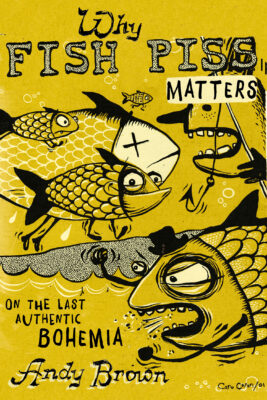
On the Last Authentic Bohemia
Andy Brown
$22.95
paper
180pp
9781550656862
Brown takes care to situate Fish Piss in its very particular time and place, addressing only briefly the political situation that left Montreal economically depressed for decades – conditions that ensured the cheap rent that has long been a boon for underemployed artists across eras and locales. Over time, the zine grew bigger and gained national distribution (hence my spotting it in Toronto). In this sense, it was a microcosm of the Montreal artistic community that exploded in the early 2000s with the global popularity of certain local bands. And like all utopian moments, it was fated to pass, as Brown details in the chapter dramatically titled “The Death of Bohemia.”
Brown takes great pains to define bohemia, but I would quibble with his use of the words “last” and “authentic.” You could get seriously bogged down in the meaning of the latter term, and as for “last,” maybe I’m naive, but I hope there’s some ragtag art scene that exists, or will exist someday, in some corner of the world.
The specific circumstances that produced Fish Piss are unquestionably in the past – along with other classic Montreal amenities like, ahem, cheap rent. (But hey, with a resurgent PQ promising another referendum, who knows? The conditions for bohemia, for better or worse, could be closer than we think.) Nonetheless, the community around the zine has continued to thrive. Contributing writers like Heather O’Neill and artists like Billy Mavreas and Rick Trembles are still producing like crazy. Constellation Records (whose concurrent rise is touched on, and which could just as easily have served as a linchpin of the emergent Montreal scene) are still going strong. And Rastelli himself is still putting on the Expozine fair and its various offshoots, attracting and spotlighting new generations of writers and artists.
For these reasons, I resist the pull of nostalgia for a bygone age, as strong as it may be. But there’s no denying that the heyday of Fish Piss was a special time, one that Brown captures beautifully in this granular and passionate tribute. mRb

0 Comments