


“Québec was Born in My Country!” is an eye-grabbing title, the kind that practically demands further investigation. Follow that demand and you will have read a book essential to Quebec’s understanding of itself – and Canada’s, too.
The quotation marks are present because the title is taken from a longer statement by Acinape and Cree educator Anna Mapachee, one of fifty-plus interlocutors whose testimonials comprise the heart of Emanuelle Dufour’s revelatory, multi-layered, multi-genre correction of colonial history. The full impact of Mapachee’s title statement hits home on seeing the sentence that immediately precedes it: “I was not born in Québec.”
“Quebec Was Born In My Country!” Wilfrid Laurier University Press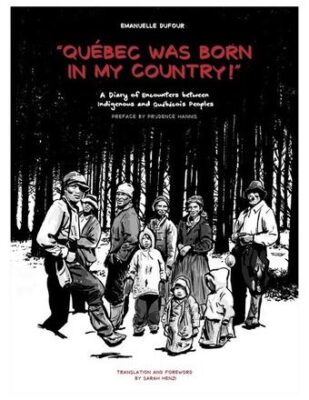
A Diary of Encounters between Indigenous and Québécois People
Emanuelle Dufour
Translated by Sarah Henzi
$32.99
paper
200pp
9781771126779
One risk with a strategy like Dufour’s is that words and images can end up blunting each others’ best attributes. In this case, the effect is the opposite: they amplify each other, achieving a synergy that somehow combines narrative pull with a start-on-any-page usefulness. The key here is the richness and range of Dufour’s subjects. A back cover blurb deploys the word “polyphonic” to describe the effect of the voices on these pages. In aggregate, though, the effect is full-on symphonic, especially as the book progresses and the individual testimonials build into an unstoppable collective moral force. (Praise is due Sarah Henzi for a translation that draws from multiple sources yet achieves a unified tone.)
The only way to give a fair sense of the voices Dufour has gathered is to quote a cross-section of them. Here, then, are five, chosen at random:
“The media only talk about First Nations as problem communities.” – Lise Bastien, Wendat, Director, First Nations Education Council.
“I am not Québécois because I am not accepted as a Québécois.” – Jean-Yves Sylvestre, Québécois and Haitian, Intercultural facilitator, Ahuntsic College.
“At the start of the (Oka) crisis I did not want the Mohawk to draw any attention because I thought the white people would just hate us more. Eventually, I understood the impact of being heard.” – Melissa Mollen Dupuis, Innu, columnist, co-founder of Idle No More.
“In 2011, I studied for a year at York University in Toronto. That is where I found out that there were Indigenous Peoples in Canada. Before that, I only knew that there were some in the United States.” – Léa-Lefevre-Radelli, French, Ph.D. in Religious Studies and Education.
“…in Québec, people are afraid of altercations, of those who get angry, and who exert pressure tactics.” – Guillaume Dufour, Elementary school teacher, brother of the author.
The encounters represented in these pages do not take the form of dialogues or conversations, though at times they read uncannily as if we are privy to a series of face-to-face exchanges. The catch is that one side of the exchange stays silent – or more accurately, speaks volumes by the simple act of listening. And as is made clear time after time, the desire and willingness to listen has been the single most important element missing from the historical relationship between Indigenous peoples and settlers in Québec. “Québec was Born in My Country!” provides hope that the tide might be starting to turn. mRb
0 Comments