



The title of Curtis John McRae’s debut short story collection, Quietly, Loving Everyone, already captures what I take to be the book’s central ethos: the bittersweet tension between individuality and community, solitude and connection – a tension at the heart of what it means to be human. “The collection as a whole,” says McRae, “is interested in loving from a distance. It’s punctuated by that comma in the title, too – a sort of separation. The collection explores failed love, love from a distance, our complicity in each other’s lives, and our accountability in the lives of our loved ones.”
Composed of eleven pieces, Quietly, Loving Everyone is itself a love letter to the city. The stories – some linked within the same narrative arc, others standing alone – weave a web of intimacies in a shared world: Montreal and its surroundings. Fittingly, I met McRae on a warm spring day for coffee under the budding trees of Parc La Fontaine, where we talked about living, loving, and writing in Montreal.
McRae, who grew up “a Montrealer, but not quite” in the West Island, learned to love the city from a distance. “I wasn’t accustomed to it,” he says; “I was always sort of on the outskirts.” The city – all cities, we agreed – insist on a kind of intimacy with strangers that is lacking in the suburbs. “Your lives become intertwined, you have no choice in the matter,” says McRae. “If you have thin walls, you smell what your neighbours are having for dinner, and you hear their arguments, you know what music they listen to.”
There is a lonely quality to this kind of closeness with strangers, a proximity that lacks intention, one that McRae occasionally visually evokes. In “Hundred-Year Floodline,” McRae’s protagonist watches from a kayak on the water while his father and his father’s new girlfriend dance in their well-lit living room on the shore. And in the collection’s titular story the protagonist relates an anecdote to his long-term, on-again off-again lover – with whom he is now embroiled in an illicit affair – about his parents listening to the couple next door’s private conversations through a glitching baby monitor. To observe, from a distance, intimacies between strangers, can distill in one the sense of being alone. But, argues McRae, “there is also something incredibly soothing about feeling lonely in your own apartment, then leaving and seeing hundreds of people out in the park.” In the city there is space for both: you can be lonely in a crowd, or you can embrace, like a protective hug, the comfort of anonymity.
A more painful interpretation of loving from a distance is the metaphorical separation from people who might be deeply enmeshed in one’s life. “I’m kind of obsessed with the idea that we can try to show up for somebody, with love, when they need us, but we ultimately fail them because the ways in which we’ve learned to love are failed and fractured,” explains McRae. “What we bring in an act of trying to help is actually damaging.” Some of the characters in Quietly, Loving Everyone suffer the worst-case-scenario consequences of this distance, which, judging by the number of rather heavy-handed (overt or implied) suicides in the stories, McRae seems to figure is death by one’s own hand.
Sometimes the equation is simple, à la “hurt people hurt people” (or, in McRae’s case, hurt people hurt themselves). Seymour, a recurring character, has a difficult relationship with his aloof and tough-loving father – and a penchant for self-destructive frenzies. Rose, who also reappears (though returning more often as ghost than person, because we learn of her suicide in “Hotel Viviane”, the collection’s first story), is shamed and ostracized by her mother and stepfather in what they believe is an act of protection. Both instances illustrate moments in which ill-fitting old-school varieties of love can cause alienation and pain; a classic case of perpetuation.
Quietly, Loving Everyone Véhicule Press 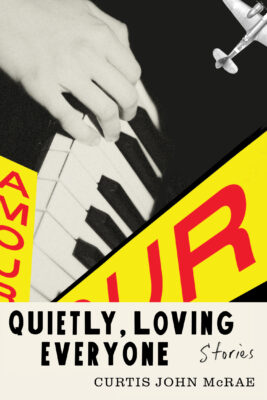
Curtis John McRae
$22.95
paper
200pp
9781550656756
What is complicated, interesting, and wonderfully articulated in Quietly, Loving Everyone, is the fact that there is no clear delineation between past and present, no extricating one from the other. Set sometimes in the 1990s and sometimes in the 2020s, the collection is littered with anachronisms. This is woven into the fabric of the city: “There is a nostalgic element to Montreal,” says McRae, an element that he most clearly explores in “Love Cinema,” in which the city’s iconic Cinema L’Amour serves as the backdrop to the beginnings of a love story. “There’s something sort of… liberal, about the idea of a porn theatre blatantly shining its marquee onto the street,” he continued. “Yet, in the strictest sense, there is something conservative about it, it’s something that’s been preserved from the past.”
Other times, these anachronisms are emotional. McRae deftly tackles the intertwined and stalling emotions of grief, mourning, nostalgia, and guilt, and how they figure within the relentless march of time. In “We Should Change the Curtains,” Rose’s Mom and stepfather sit smoking in their dusty living room, the shower curtains growing mould, stuck in the mud of grief as they replay the tragic death of their daughter. In this instance, it seems, guilt and grief keep the characters locked in the past, shaping them into anachronisms themselves.
“I’m interested in the idea of inheritance,” says McRae, “and the ways we try to get rid of old notions or ideas, but also the ones that last, and how they last, and why? How aware are we of the ways in which they show up in our lives?”
The past can haunt us, the present hurt us, and the future scare us. But the past can also nourish or teach us, the present ground us, and the future inspire us. Just like how we can feel alone or together in a city (and sometimes both at the same time), like how both moments of loneliness and connection are fleeting, we live in a soup of things past, things happening, and things still to come. The world, and time, is cyclical. Or are we a pendulum, swinging back and forth? “It’s precisely that grey zone that I’m interested in,” says McRae. mRb


0 Comments