


Montreal once attracted artists from all over with its affordable housing, shaping the city we know today as one defined by its arts and culture. Over the past four decades, however, developers have been working towards efficiently transforming low-income neighbourhoods into gentrified spaces and condominiums. These changes, motivated by profit, have displaced the residents of these areas, unconcerned with the people who have been living there for decades.
Squat the City! Kerspledebeb Publishing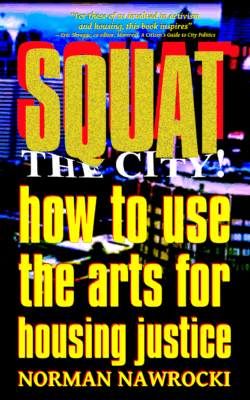
How to Use The Arts for Housing Justice
Norman Nawrocki
$20
paperback
160pp
9781989701416
Nawrocki shows us how all artistic media have radical potential. Rhythm Activism, a group led by Nawrocki and Sylvain Côté, used their theatre and music background to create works specifically for the communities they were performing for. Un logement pour une chanson (A Home for a Song) was a free cabaret show touring several low-income neighbourhoods across Quebec. The script was easily adaptable to include details from each neighbourhood they performed in, and in each show the “condo vampires” were driven out by an organized tenant opposition protecting their community. Including songs, skits, and political satire, the cabaret was immensely rousing for audiences, speaking directly to the issues impacting them most. Nawrocki notes: “Groups told us later that each show added more names to their membership lists of tenants willing to demonstrate in the streets to back up and shout or sing out their demands.”
Artistic practice and activism have always gone hand in hand. In Overdale, an inner-city neighbourhood in Montreal, the fight against developers incited an outcry from the community. Tenants (many of whom were also artists) mobilized those around them through music, poetry, and large-scale cultural events. One such example was a “backyard” cultural event entitled The Horror of hypocritical faceless bureaucracy; the Terror of ruthless developers; the Fear of homelessness. Tenants, activists, and passersby came out in numbers, and the combination of musical acts and poets directly addressed their concerns to a crowd of those equally outraged.
The following week, the tenants met up with officials at city hall in hopes to convince the city to step in and protect the buildings. As it turned out, “the officials admitted that by chance, they had actually witnessed the back-balcony musical protest while walking through the area… a special moment that convinced them of the existing vitality and community spirit of the neighbourhood, and the need to preserve and nurture it.” This resulted in the creation of the Anderson Housing Co-operative, which still exists in the neighbourhood today.
From wide-reaching mural projects by Artifact, Artists For Action/Artistes Font l’Action, a feminist group of female artists, to Frederick McSherry’s Maison de chambres/Rooming House Show, an exhibition in one of the empty houses featuring the work of fourteen other local artists, Squat the City! provides countless examples of creative projects for those who are fighting within their own communities now. There are a multitude of ways that can combine the theory of housing justice with practical artistic applications, and Nawrocki reminds readers that this is an issue that impacts everyone; no one is exempt from a basic necessity like housing, especially artists. There is no one outside of this fight; the way forward is banding together, with all the tools available, towards housing justice for all.mRb
0 Comments