

Montreal author Joel Yanofsky’s memoir, How to Move On: An Unfinished Memoir of Loss, Love, and Surviving Your Family, was originally meant to read like a “how to” guide, but it became something slightly different. Published posthumously, the memoir still provides a sense of closure despite being unfinished upon Yanofsky’s passing, with his wife Cynthia Davis and his friend Bryan Demchinsky (co-editor of with Elaine Kalman Naves) piecing together the remainder of the book and enclosing within it their respective preface and introduction.
How to Move On Véhicule Press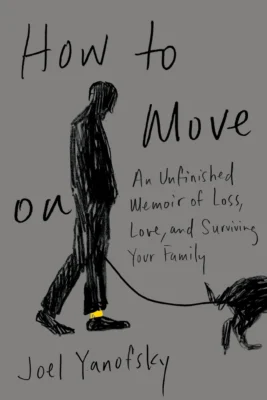
An Unfinished Memoir of Loss, Love, and Surviving Your Family
Joel Yanofsky
$19.95
pa
200pp
9781550656930
At that time, the author himself was grappling with his own troubling health issues, separate from the coronavirus, while he and his wife continued to provide for their adult, autistic son, whom Yanofsky has written about more extensively in another memoir called Bad Animals: A Father’s Accidental Education in Autism. As How to Move On travels back and forth through Yanofsky’s past and present, the deaths of loved ones circulate nearby, wildly and unexpectedly, much like the pandemic itself, and Yanofsky reflects upon loss after loss, as well as the deepening insight each one would eventually bring.
It is important to note that this memoir is not meant to be judged by its cover, nor its title, because more often than not, it is laugh-out-loud funny. From a badly behaved, and self-entitled, pet dog named “Harvey Weinstein” to an ambiguous family recipe that instructs: “1. Olive oil, loads of garlic. 2. Throw in tomatoes. 3. Tomato paste 4. Then add the meat and a dash of sugar 5. Simmer for hours,” to the author’s shameless self-promotion on his own gravestone, which reads: “I wrote a few pretty good books, consider this a plug,” there is no shortage of laughter in the face of the book’s more serious subject matter. Other topics in the memoir include intergenerational trauma, disability (both visible and invisible), sticking together amidst betrayal, and of course, the memoir’s main themes: death and grief, but specifically, an exploration of these in a cumulative context.
Wonderfully and thoroughly Montreal, Yanofsky’s memoir also delves into the nuances of Jewish identity, growing up middle class in the suburbs of Laval, the balancing act of being an artist with making a living, and all of the beautiful and complicated interpersonal relationships that develop in between. He writes: “I have never been a fan of fantasy or science fiction. The actual things that happen in people’s lives, in my life and that of my family, have always struck me as weird and inexplicable enough,” which is a throughline that is closely explored and unpacked throughout the memoir. Yanofsky’s writing is candid, cheeky, and empathetic, and he is unafraid to lean into his innermost fears as equally as he softens those very anxieties with humour.
Overall, while How to Move On did not become the exact “how to” manual it was originally meant to be, it still manages to deliver on its original intent, by prescribing a healthy dose of medicinal laughter, and a deep appreciation for the people and things that matter in life and make it worth living.mRb
It is unfortunate the reviewer did not mention the role my co-editor Elaine Kalman Naves played in the creation of this book. It was substantial and essential.
Fixed to include this credit