


In Native Immigrant: A Personal Journey into Our Home and Native Land, visual artist-turned-writer Carolina Echeverría interweaves personal memoir with cultural reflections on identity, place, and relationality. With a candid, almost journal-like intimacy, Echeverría invites us into her life, tracing her journey from a childhood in Chile to her eventual immigration to Montreal. Throughout the book, her writing is marked by honesty and vulnerability, even when recounting personal moments that reveal her as imperfect and deeply human. In no way does her writing shy away from the complexities of her own humanity or that of others.
Native Immigrant Agapé Books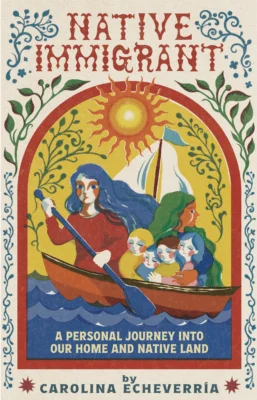
A Personal Journey Into Our Home and Native Land
Carolina Echeverría
$26.95
paperback
200pp
9781069636805
Echeverría’s friendship and conversations with Mohawk War Chief Ateronhiatakon (Francis Boots) frame the entirety of her memoir – taking up what it means to re-root in a new place. Beyond this, she also delves into other formative relationships: finding a sense of community with her host family during an exchange in the US and falling in love with her now-husband Alain during a trip to Puerto Vallarta. Her memoir drives home that we are not formed in isolation, but rather are the product of our relationships – the people we choose to love. In our rather polarizing political climate, there is nothing more important than bridging cross-cultural divides and finding places where we can meet each other.
Echeverría reflects on the singular challenge of packing one’s life into a suitcase, knowing that “whatever you bring will represent the life you left behind,” while exploring the emotional and cultural weight carried across borders. Among the most compelling aspects of Echeverría’s book are her perceptive and nuanced reflections on religion, gender, and political resistance. While exploring these topics, she never distances the reader from her story, but instead keeps us present in her life.
While serious in undertone and topic, Echeverría’s meditations on religion bring forward levity and humour, offering the reader a clear sense of her voice. I broke into laughter as she referred to God as “the super-landlord” and likened Noah from the ark to Al Gore, Naomi Klein, and David Suzuki in that “[n]obody cared back then either.” She brings contemporary understandings to long-held ideas about Catholicism, making them genuinely engaging and unexpectedly funny. Throughout her writing, bodily autonomy and resistance also recur: she frames controlling her own sexuality as her first anti-patriarchal act and recounts holding mirrors to soldiers’ eyes as a child, directing beams of sunlight into them – small, defiant acts of resistance that highlight her inventive, rebellious spirit. Throughout the book, Echeverría does an artful job of providing the reader with precise details from her life that show us who she is and brings her story to life off the page.
If you’re looking for an honest exploration of self-discovery and belonging, set against the cultural backdrops of Chile and Canada, this memoir is it. Echeverría brings you into her story, surprising with her sharp insights, emotional sensibility, and depth of character.mRb
0 Comments