

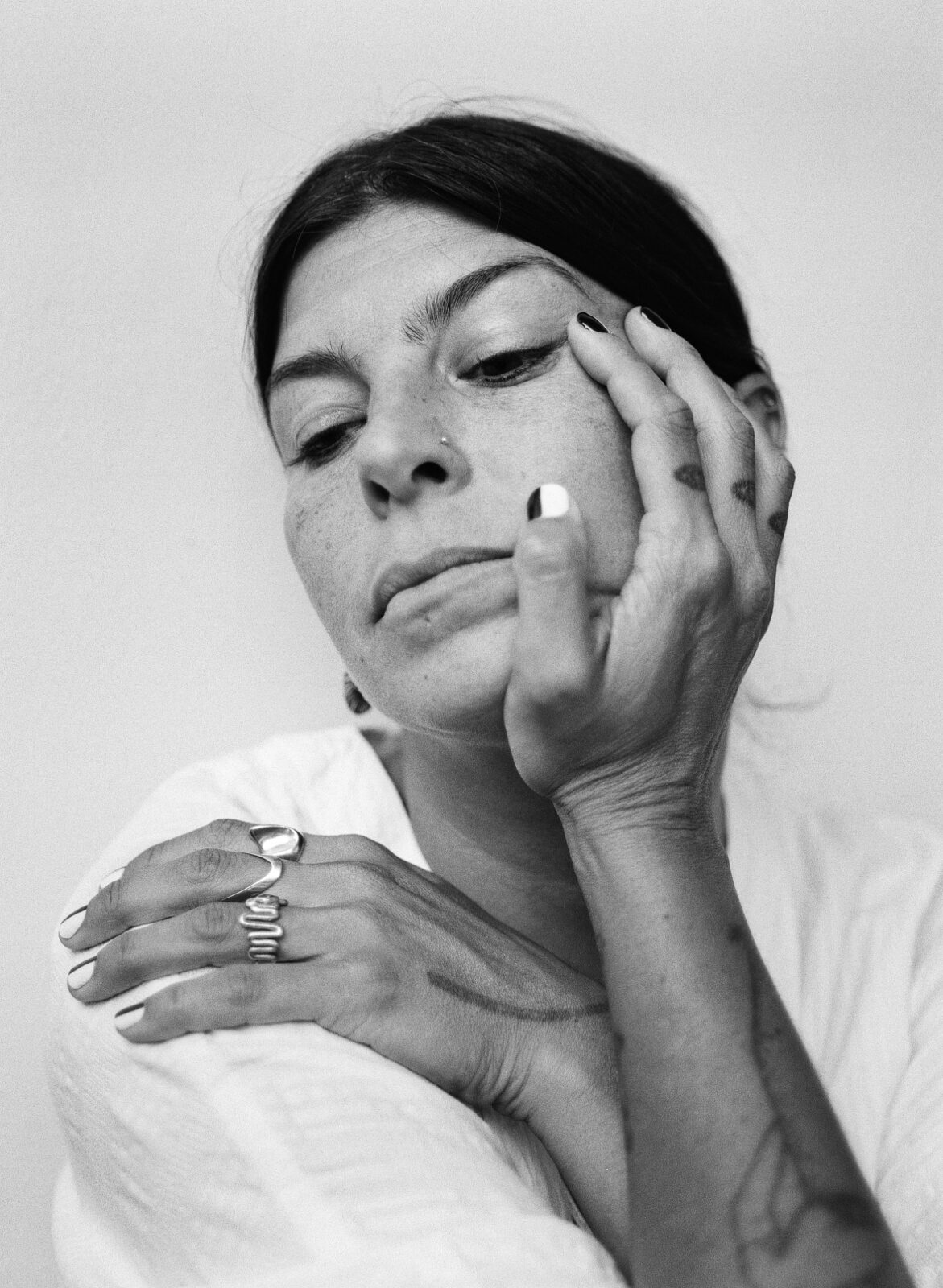
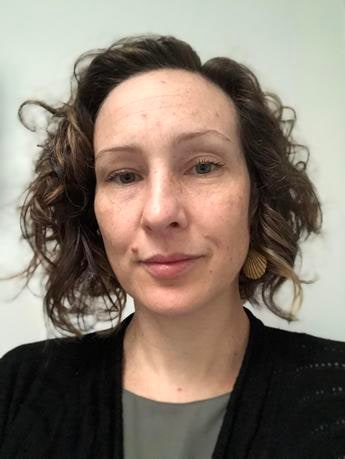
When we meet for our interview, Alexei Perry Cox has just returned from visiting loved ones in Venezuela, a trip which coincided with the American military strike and capture of the incumbent Venezuelan president. Until the last moment, neither of us were certain whether her flight would be permitted to return to Canada. As she Zooms in for our conversation from her sunny Montreal office, a charge crackles in the air. Through the digital interface, Perry Cox’s passion, openness, and commitment to empathy vibrate – as do the pain and uncertainty of our global moment.
This same affective electricity pulses through and off every page of [SPACE]. A quantum entanglement of love and grief, Perry Cox’s deeply political project accumulates language from books by contemporary Palestinian and Indigenous Turtle Island poets writing in English, arranging each work’s phrases into a prose poem. “These are lines gathered from specific collections that I love with all my heart,” she says. But, she adds, she also wanted “to complicate that gathering of love by talking about how strange it is to gather it all.”
[SPACE] Coach House Books
Lessons in Taking and Making
Alexei Perry Cox
$24.95
paperback
140pp
9781770569027
Such concerns gave rise to the project’s formal conceit. Modelled after the popular game Mad Libs, [SPACE] extracts words, leaving the poems riddled with gaps, blanks, and breakages.
The words that I chose to take out were (a) the PERSON(s) and PLACE(s); then (b) the SPACE(s); then (c) the WIND(s) and BREATH(s) or BREATH(ING) […] then (d) linguistic subjectivities such as LANGUAGE; and finally abstractions like LOVE and NATION and IMAGINATION. […] I often found it most difficult to remove the EXCLAMATIONS in the works, such as Please!, Stop!, No!.
As in Mad Libs, the reader is given a word list before each poem, asking them to fill in grammatical elements such as “PLACE,” “NOUN,” or “PERSON.” Early on, [SPACE] lists the actual words removed, such as:
gaza
gaza
heart
people
breathe
existence
The reader is thus implicitly presented with a choice: return what was taken, or transfigure the text into something new.
I ask Perry Cox about this textual structure. With subject matter so far from levity, why adopt the form of a game, literally inviting the reader to “play”? “If we don’t know how risky it is to play games, then we don’t understand how we’re treating each other’s lives,” she replies. “Everybody’s already playing it, whether they read this book or not.”
We have taken out children. We have taken out Palestinian men. We have taken out Navajo. We have taken out their words and language(s). We have taken out body. We have taken out Trail of Tears. We have taken out Gaza. We have taken out love. We have taken out nation and imagination.
What can we put back in?
[SPACE] is keenly aware of the violence of its interventions, stripping landscapes of “life,” “language,” “aliveness,” removing bodies, body parts, breath. A project of this nature, if not carefully handled, also risks the symbolic violence of homogenizing the communities it depicts, collapsing disparate cultures’ cosmologies and concerns. Similarly, addressing a “we” might risk assuming the reader’s subject position, or even inadvertently implying that this book – and, by extension, its ethical project – is intended for only one audience.
When I ask about these dangers, it is clear Perry Cox has considered them deeply. Her interests lie in our (inter)communal obligations, the “threshold spaces” of imperfect empathy. The book is “not saying ‘here are the answers,’” she says. “It’s more, ‘here are the problems [and] questions.’” While we may not always share the same responsibilities, or even know what those responsibilities are, [SPACE] invites us “to pay attention and dedicate commitment.” We must, she says, “allow ourselves the error and the nuance and the play, that bravery or foolhardiness. We have to trust each other enough to at least try.”
She adds, “As confounding as it is to try to write about, I think it’s more dangerous not to.”
[SPACE] rejects any easy epiphany, stating: “This is not meant to be a transcendence for you.” Perry Cox says the book is “not going to be a balm. I want the communal obligation to be more important than the personal transcendence. I want us to dream our relationships with ourselves and our communities.” “Born Palestinian, Born Black,” composed from Suheir Hammad’s collection of the same name, reads as a prayer to honour this dreaming:
[…] every plane of my life i
offered poetry to make sense of things. none of them are pieces I could
write now, cause i’m no longer living in those ___________. But they’re still
real and ___________, cause those ___________ are within me.
What is within us? What will we put back in?
[SPACE] calls us to consider the realms of possibilities and risks inside and between us, to recognize the games we are all already playing and ask how we might reimagine their rules. If [SPACE] does not embody an authoritative position of political purity, that is its strength – it calls not for infallibility but commitment, our flawed and whole selves, in all their mess and capaciousness, in potential solidarity.
“There is less to be afraid of if we share more,” says Perry Cox. “Being [a] composite of disconnection as well as points of entry – that’s not a bad place to be.”mRb
Photo: Hamza Abouelouafaa
0 Comments