


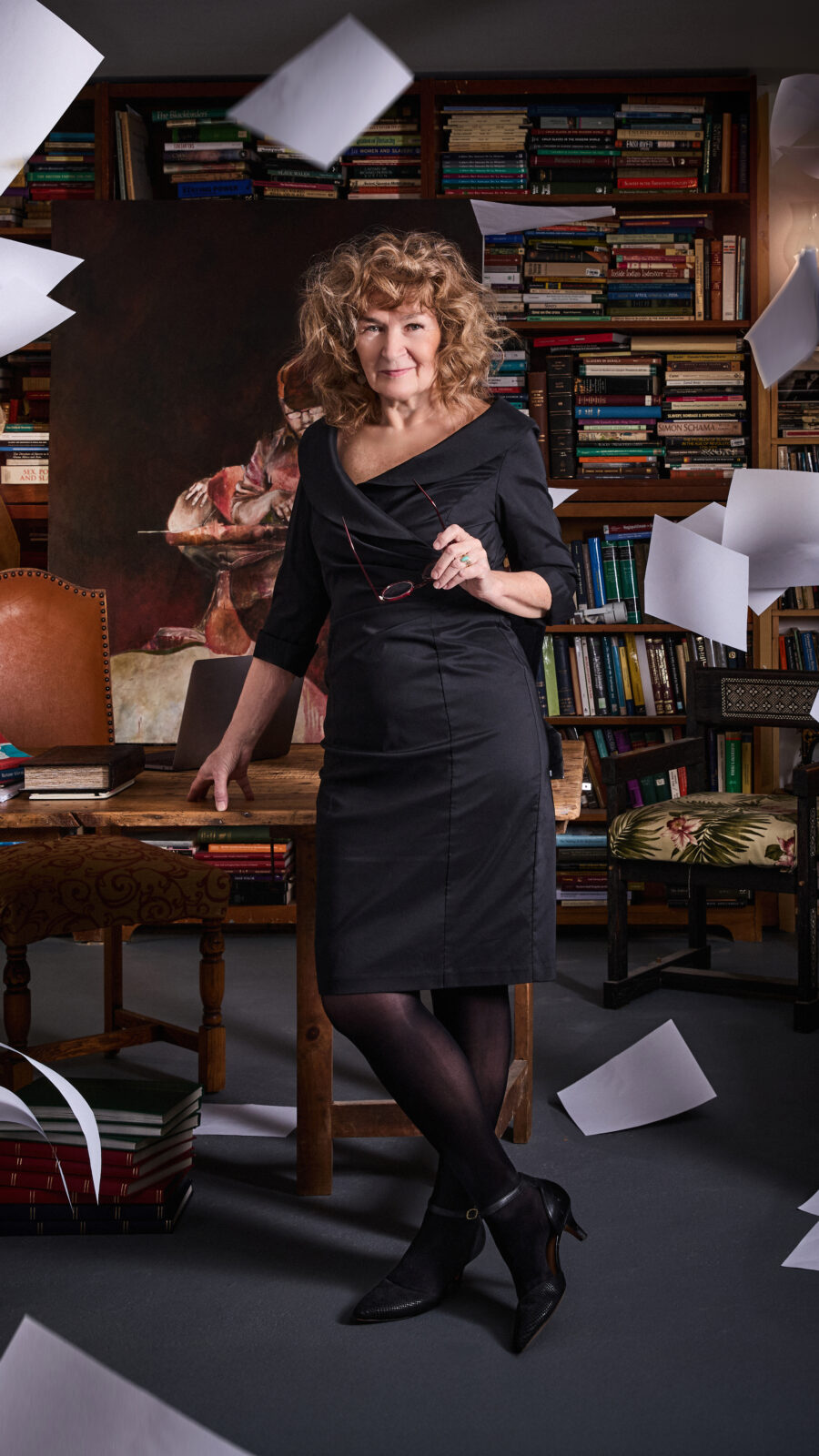
Over the past thirty years, Marianne Ackerman has established herself as a mainstay of Montreal’s literary community, producing more than a dozen plays and novels that chronicle life in Quebec leading up to and after the Referendum. In her latest book Oyster, Ackerman returns to the landscape of her childhood in Prince Edward County, a rural municipality about two and a half hours’ drive east of Toronto.
Known colloquially by locals as simply the County, it’s a region that, in recent years, has become a popular destination for tourists and Torontonian expats looking to swap the city’s busyness for a taste of rural living. Proximity to provincial parks like Sandbanks and world-renowned vineyards have catapulted the County to the top of Canada’s list of most desirable staycations – a feat which has had a polarizing effect on longtime locals.
Oyster Dundurn Press
Marianne Ackerman
$24.95
paperback
256pp
9781459757035
This, she says, is “the big conflict within the County right now. People are moving in, and some have been there for maybe twenty years now. And still, the old-timers are like, What? Where’s the neighbourhood going?”
Social change – both those who applaud it, and those who resist it – is familiar terrain for Ackerman’s fiction: her first novel, Jump, was set during the 1995 referendum. In Oyster, it’s a subject Ackerman addresses on a microscale, within the dynamics of a family on the precipice of change.
“I wrote to find out what I think about a family that basically collapses with the death of a patriarch,” she says. “What will it take? What would it take to keep the clan going? It takes the centre.”
So goes the Yeatsian adage – “things fall apart; the centre cannot hold” – and Oyster begins quite literally with a tumble: protagonist Amelia Cameron, a one-time bestselling author, receives a call at her home in Toronto’s Cabbagetown informing her that her father, Harold, has fallen from the roof of his County farmhouse. In the wake of his death, Amelia and her siblings must determine not only how to divvy up the family estate, but also how to relate to one another in the absence of the centre who grounded them all.
It’s a question, Ackerman writes in the book’s foreword, that has preoccupied her since the death of her own father in 2007. Like Harold, Ackerman’s father also died in a “freak accident,” leaving behind a tangled legacy. “It really threw our family into a state,” she says. “It did really unleash a crisis, or a reconfiguration, of who we are in the family.” But that, she says, “is a different story.”
Indeed, a book written in the first person with an author protagonist dabbles dangerously close to the realm of autofiction – tricky business, when family secrets are on the line. With some bits seemingly lifted from life, it’s a question I put forth to Ackerman: How does she view the genre of this story?
For Ackerman, Oyster is something else altogether. “It’s like a bird’s nest,” she says. “You look at a bird’s nest and you’ll see tiny bits of cloth and things the bird has gathered up from around the yard – little, very familiar pieces have gone into the weaving of it. Yet the thing itself is a totally different home now.”
Indeed, while the death of the patriarch serves as the book’s catalyst, there’s another major plot woven throughout: literary fraud. At Harold’s funeral, Amelia is reunited with her niece Ginny Gupta, newly admitted to Concordia’s creative writing program on the basis of a promising outline for a novel. When Ginny later calls Amelia in tears, complaining of writer’s block and irritating classmates, Amelia invites her to visit in Toronto. What ensues is a wine-soaked weekend in which Amelia, eager for reprieve from a slogging rewrite of her own latest project, begins filling in the holes in Ginny’s outline. The resulting book, The World is Your Oyster, is a hit with Amelia’s agent Barry and launches the two women into a flurry of stardom and scandal.
Satires about tokenization in the publishing industry have become a trend in recent fiction, including R.F. Kuang’s Yellowface (2023) and Percival Everett’s Erasure (2011). Written contemporaneously with these novels, Oyster follows in the same tradition, drawing its inspiration from the true story of Romain Gary, who famously won the prestigious Prix Goncourt in 1975 for his book La vie devant soi, published under the Algerian surname Émile Ajar. When the time to accept the prize came, Gary enlisted his nephew Paul Pavlowitch to give a face to the pseudonym. In this way, Ackerman sets up Amelia and Ginny as modern-day female analogs.
“I love intergenerational stories,” says Ackerman. “Parents and children have been kind of done to death, but aunts and nieces, they really interest me.”
Ginny and Amelia’s plotline plays on the overarching theme of familial relationships and secrecy – especially when Amelia learns that Ginny’s outline is based on her childhood, threatening to blow family secrets out of the water and terminate Amelia’s already strained relationship with her sister Jean, Ginny’s mother. It also raises questions about the future of CanLit, and positions Amelia as a writer, much like the County that produced her, at a crossroads.
Just as Ackerman namedrops familiar hallmarks of the CanLit industry, such as the Frankfurt Book Fair (“That dying circus?” her agent scoffs) and the ever-troubled Giller Prize, so too does she reference real local businesses within the County: Amelia and her sister-in-law visit Ste. Anne’s Spa in Grafton; she and Barry have a drink at the waterfront Drake in Wellington. Both these communities – the County, the Canadian publishing industry – are insular: everybody knows everybody. I ask Ackerman why she decided to situate the high-stakes scandal of Oyster amidst real-world referents – why not set the drama in a fictional town of Anywhere, Ontario?
Specificity, it turns out, is the point. “I think places, communities, are hungry for looks at themselves, whether they agree with it all or not,” Ackerman says. “I think that I’m a turf writer. I always have been. I think that people’s social and even geographical context has a big impact on personality and options, choices, who you are, identity. I love exploring that. I could not be a speculative writer, put somebody in a made-up place.”
Likewise, Ackerman continues, “I don’t tell any of my family secrets. But I hope I root out everybody’s family secrets.”
It’s in the attention to the particulars, in other words, that universal themes emerge – a lesson Ackerman credits to her time in theatre.
“I think those little family problems loom very big in people’s lives. I think that’s still where we should put our attention, no matter how much the world is,” she says. “I’m becoming less political as a writer as the years go by, because I feel less and less we need to capture the moment. And who would capture this moment? What? What kind of a task would that be?” She gestures around, invoking the happenings of the past ten years – the pandemic, two Trump presidencies, political unrest at home and abroad. “I’m more interested now in eternal themes like, how do we misunderstand each other? What kind of moves do we make, despite ourselves, to pull up some kind of meaning out of our personal lives? Which I think is really what I like to write about.”mRb
Photo: babvisual.com
0 Comments