


Physical Education is a title so pointed, it’s almost a spoiler. At its core, it’s a meditation on how the life of the mind – especially when it’s filtered through the chaotic ADD of smartphone feeds – distances us from being grounded in what’s real, while physical presence and proximity can help return that connectedness.
Physical Education Pow Pow Press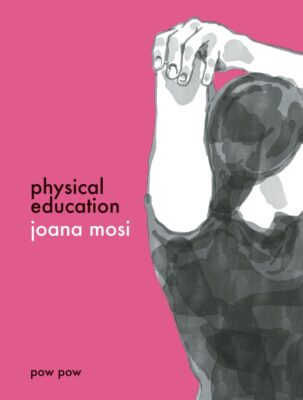
Joana Mosi
$29.95
paperback
170pp
2925114601
Laura has recently won a prestigious grant to finish her first novel, and everyone in her social scene has heard and seems eager to talk about it. But her reticence on the novel’s progress makes it clear that Laura is stuck. She’s unable to focus on her work, flipping between her writing laptop and phone, where she idly browses the endless flow of content that’s always just there.
Floating panels of unread-message notifications and headlines recur frequently enough that Laura’s phone starts to feel like a character, given presence through iteration and highlighting the grind of smartphone ownership and its endless invitations to engage. Mosi surfaces the scattered attentions of the digital moment with an elliptical storytelling style that builds weight and momentum through repetition. At times, it can be a bit hard to follow her narrative threads, but that’s kind of the point – our understanding of our own lives and others’ is shaped by one-off snapshots, but it’s often unclear whether these moments matter or are merely Instagrammable.
Mosi’s drawing style offers a sharp contrast to the crisp precision of digital graphics. She deploys a shaggy, rounded line with patchy splashes of fill, a loose style that works best when it’s communicating vibes, as in one nightlife scene where Laura’s cathartic release is clear in just the shape of her blouse in silhouette as she dances.
Mosi also zooms in on odd moments, dedicating whole pages to sequences showing each step of some usually mundane action that typically wouldn’t merit depiction at all: fingers rolling a cigarette, a cropped torso doing reps, hands opening a wine bottle. Her care in detailing these actions strikes a contrast between bodily, connected everyday rituals – peeing, working out, making out, taking a nap – and the listless ephemera of our mediated lives. Images from passively consumed social media and films form a layer between Laura and her friends and the outside world, an interpretive lens that permeates and overlies everything else.
Physical Education follows Laura on a few trips to the gym with friends, where she’s forced to put her phone down and engage. Mostly, she pushes weights and chats, but her social group is intrigued by the onsite pool, and near the end of the book, Laura dives in.
In the water – no phone, no escape from the physical immersion in a sensory embodiedness – Mosi introduces a totally different aesthetic and art style, darkly inked with churning water filling most of the page, just cropped bits of Laura’s body floating by. Totally disconnected from her phone and her social scene, she’s shown grounded in the physical life of her body, where she is, for once, actually connected. mRb

0 Comments