

Karine Rosso’s Between the Island and the Turtle opens at the dawn of a new year, with a countdown from five and a stated intention to “embrace solitude.” The early pages of the novel pass impressionistically, and it soon becomes clear that the year in question is 2020. The pandemic encroaches upon the narrator and her daughter, and the cruel irony is that her year’s goal – to embrace solitude – has been decisively fulfilled. “What do we do now that time is collapsing?” the narrator asks. We turn to the past, the novel answers.
Between the Island and the Turtle QC Fiction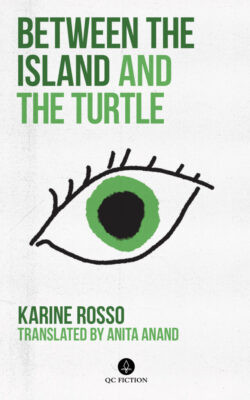
Karine Rosso
Translated by Anita Anand
$16.95
paperback
201pp
9781771864015
Rosso’s narrative surrogate determines to use this imposed solitude productively. She unearths a long-abandoned book project: an account of her travels through South and Central America in the early 2000s, selling handmade jewellery to tourists, making fleeting but enduring connections with locals and other travellers. These kinetic scenes are vibrant, critical, and absorbing, but the narrator cannot commit fully to her past because of the intensive pull of her present.
Stitched into these excerpts are apt and difficult reports of more immediate scenes of crisis: the epidemic of unhousedness that becomes newly visible during the early lockdowns, and the creeping isolation of watching the street from inside one’s home. Interwoven with empathetic reckonings of the displacements exacerbated by the pandemic is the narrator’s account of the sudden onset of visual impairment, during a time when vision has become the primary mode of contact with the world:
It’s obvious that each successive wave came to deposit huge stones on your life’s already rocky riverbank, contributing to the wall erected along your brain’s central sulcus, near the corpus callosum, the bridge connecting both hemispheres and relaying information through its median structure scaffolded on the lateral ventricle, an image found on the web.
Even in moments of specificity pertaining to the narrator’s neuro-ophthalmologic crisis, Rosso braids her reader into these experiences of disconnection. There are moments when the book feels almost too close to the lived texture of early lockdown; the duality of insulation and exposure blur into a virtual hellscape of solitude and disembodiment. It is easy, and unsettling, to read oneself into the “you” of the narrator’s voice.
While the novel can be bracing, it also offers some sense of catharsis: “You still take refuge in fiction,” she writes, “because the voices discussing literature on the radio are the only ones that succeed in bringing you out of your misery.” These figures of literature, some canonical, some closer to home, orient the narrator as past and present crises blur together – Don Quixote foremost among them. Like Cervantes’s knight-errant, Rosso’s narrator is acutely aware of the danger of narrativizing one’s life through inherited forms. Don Quixote does not see the world as it is because he cannot relinquish the stories that once sustained him. Between the Island and the Turtle asks what happens when you intentionally loosen your grip on those sustaining narratives. mRb
0 Comments