


In the 2022 documentary Black Ice, produced by P.K. Subban (that I tell everyone I know they must watch), one of the hockey players interviewed is Wayne Simmonds. I found myself in a kind of state of disbelief when I first came across the footage of him at six or seven years old, being interviewed. The interviewer asks him, “What was your favourite part of the game?’’ Young Wayne responds with, “When I got my first hat trick.’’ I feel like witnessing this footage was more than the (highly important) discourse of “seeing representation.” To reduce his early presence to representation would be to miss the sociological weight of what I experienced in that short clip. The young Simmonds reveals something far more radical: an active, unburdened belonging, within a sport in which socioeconomic barriers and cultural gatekeeping dictate that Black children should feel like outsiders. Simmonds is entirely within his element. We see a normalized, unshakeable joy for the game. It is the sociological normalization of a Black child claiming absolute ownership of space, and it happens to be within hockey. He is at his maximum potential before the institution has a chance to define him. A prime example of what happens when one’s potential is fully met.
Black Aces Triumph Books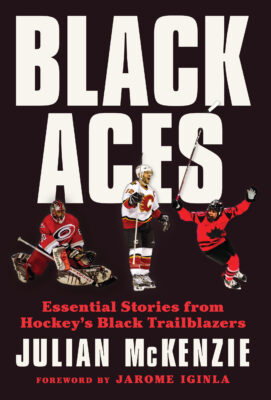
Essential Stories From Hockey’s Black Trailblazers
Julian McKenzie
$38
hardcover
256pp
9781637278628
Mckenzie’s book opens with a quote by Jarome Iginla: “Black Aces made me think back to when I was younger what it meant for me to follow other Black players into the NHL… trying to follow their stories and what it meant for me to follow my dream and to know that is possible.’’
And speaking of prime examples of potential being fully and absolutely met: P.K. Subban.The beloved, radiant defenceman is symbolic of some of the most interesting sociological ideas. To start with, the delicate line of how unapologetic a player can be within the traditional structure of a very conservative game. Hockey likes to hide its diversity. Subban operated as a mirror held up to hockey’s traditional institutions. While the sport defended the illusion of a purely statistically based meritocracy, Subban’s career exposed a different reality. McKenzie masterfully highlights how the institution judges a Black athlete: not just by performance, but by invisible racialized code of performance. Subban represents a kind of shift that wasn’t necessarily acknowledged or welcomed within the hierarchy of hockey. In Black Aces, Mckenzie covers the glory as well as insider information, such as Habs owner Geoff Molson interfering in the scandalous Subban trade that caused aneurysm-level outrage among fans.
Georges Laraque shatters the machine entirely. Built to occupy the most hyper-violent, physically punishing role the institution could manufacture, “Big Georges” stood as the league’s ultimate enforcer. Yet, the most shocking disruption he brought to the game wasn’t his fists, but his insanely cultured, sovereign mind. A strict vegan fuelled purely by a profound, unyielding dedication to animal rights and non-violence, Laraque inverted the hierarchy’s expectations. He proved that a presence could hold absolute physical dominance while remaining rooted in radical love and compassion. The corporate structure demands a mindless asset it can audit and manage; Laraque offered an independent, brilliant universe that refused to be contained by their grey definitions.
McKenzie unmasks the hidden culture of the sport. His book is an incredibly sharp, sophisticated work. Black Aces has elevated the entire hockey narrative.mRb
0 Comments