


Remember the last argument you had with your significant other? Perhaps the argument had a kind of loopy quality to it, in the sense that you just kept going “round and round” in circles. If you haven’t had that experience personally, you may have witnessed a friend or loved one get into it. That’s the jumping off point of Into the Loop: An Ethnography of Compulsive Repetition.
Into the Loop Duke University Press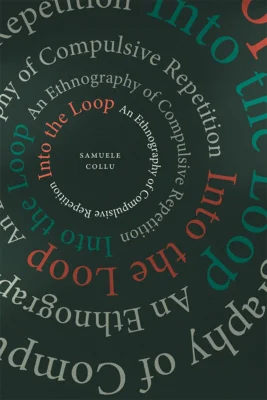
An Ethnography of Compulsive Repetition
Samuele Collu
$31.95
paperback
224pp
9781478032946
Into the Loop is based on research Collu conducted in Argentina, studying the peculiar practice of couple systemic therapy. In this practice, a team of psychotherapists watches an otherwise ordinary couple therapy session, either from behind a two-way mirror or through a closed-circuit live feed in another room (sometimes both). Immersed among psychotherapists, amid hundreds of hours of couple therapy sessions, Collu the anthropologist asks, “how and under which conditions can we interrupt the loops that define us?”
Collu proposes that the social (and psychic) fabric of the couple itself – two people fallen helplessly in love – is one such loop in which modern folks are trapped. While Into the Loop isn’t a full-blown deconstruction of the couple, it’s clear Collu isn’t optimistic about this form of love. In fact, he leans into Lauren Berlant’s concept of cruel optimism to diagnose a kind of collective disordered attachment to its wishful illusions. The cruel optimism of romance locks people into an “infernal embrace” of “never-fully-collapsing relationships” that ultimately drain their vitality. The question returns: how to interrupt this embrace?
Collu is not only after “the couple.” Adeptly woven into this conversation is another about similarly disordered attachments to screens and “algorithmic forms of governance.” In a chapter titled “Compulsive Repetitions,” he writes: “Humans have the biocultural tendency and evolutionary necessity to predict, anticipate, and delimit the realm of possibilities around them… I crave the comfort of something predictable, something that I can binge for extended stretches of time, something that could potentially never stop.” Algorithmic feeds, similar to well-trod relational loops, nourish a human weakness for familiarity.
Each of the book’s four chapters has the feeling of a montage: scenes from real couples fighting, therapeutic interventions, theoretical lenses from psychoanalysis and post-structuralism, and Collu’s own personal musings. Collu often interrupts himself: beginning with one image or perspective before suddenly shifting to a new angle. Yet many images return, ideas riff, in a dreamlike syncopation. Collu dips and dives through the wonderland of the collective subconscious armed with, as he puts it, “the fuzzy warmth of a question one asks just before falling asleep.”
Collu gestures toward possible technologies for interrupting and liberating us from heteronormative and digital trances. For example, he summons “the spirit of the situationist interruption” – referring to the European political performance art movement that began in the 1950s – as a tool for collective transformation. He calls for help in imagining “a collective practice that slowly erodes the dominant presence of some images over others.”
Collu’s gesturing sometimes feels frustratingly vague and lost in a conceptual register. I could also nag about the moments when I thought Collu was too soft on romantic delusions, or a bit too bashful in making it clear to the reader that he’s not immune to such delusions. However, I see Collu’s overall approach as a well-placed refusal to fall into the loop of being too prescriptive or preachy. In the end, I’m struck by how Collu manages to balance a rare kind of vulnerability on the page, standing right alongside the reader as we gaze into the collective mirror.mRb


0 Comments