

Despite the harsh conditions of their daily life, two young women show a fierce determination to live their lives as artists. They begin a correspondence sharing their yearnings, the many obstacles they face, the few moments of fulfillment. Because both women will become writers, their accounts are vivid, sometimes heartbreaking. But what makes this exchange especially affecting is that the letters start soon after the liberation of the two friends from Bergen-Belsen in 1945.
Letters from the Afterlife McGill-Queen’s University Press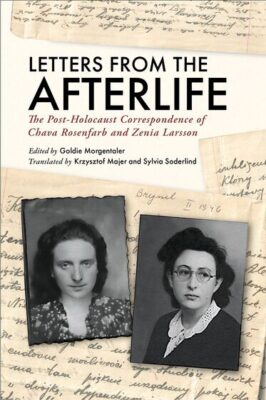
The Post-Holocaust Correspondence of Chava Rosenfarb and Zenia Larsson
Edited by Goldie Morgentaler
$39.95
paperback
328pp
9780228024668
The photos on the cover of the book, taken soon after the liberation from Auschwitz, show two young women confronting the future. Chava stares fiercely at the camera, her gaze dark, her lips tight. Zenia looks to the side, her face soft and dreamy, but with something like bitterness around her mouth. Both women are twenty-three years old, on the cusp of new lives. For the next thirty years, they will exchange letters written in their only shared language, Polish.
Their ambitions will see success. Chava will become a leading member of the Yiddish language literary community in Montreal and later an internationally known writer in English translation. Zenia will become a sculptor and, for a time, a wildly successful Swedish-language writer. Both women will write trilogies devoted to the ghetto and war experiences – though they will do so at different times, in different languages, and initially without being aware of the other’s project.
Goldie Morgentaler, the editor of this book and the dedicated, intelligent, guardian of her mother’s legacy, refers to the complexity of women’s lives lived in the “afterlife” of the Holocaust. The letters have much to say about the painful contradictions of the postwar period. Mixed with sadness, loneliness, and guilt are the immediate needs of learning a new language and adapting to the rules of a new country. There are anxious inquiries about friends and relatives who may or may not have survived. There are plans to meet, constantly frustrated by lack of money. And there is the shocking disconnect between the suffering of the war years and the attitudes of the established Jewish community.
The voice of Chava in her letters will be recognizable to readers of her novels (The Tree of Life, Bociany, Of Lodz and Love), short stories (Survivors), poetry (Exile at Last) and essays (Confessions of a Yiddish Writer) – the same commitment to honesty, the same respect for emotions, whether they be socially appropriate or not. Relations between the two friends become strained at times, and Zenia is silent for long periods. Chava is the more persistent writer, more determined to keep the friendship alive and meaningful, yet she goes through sterile periods in her writing: “I hate words. Every word I use seems threadbare, rotten, stale.” Zenia struggles with wood and stone, often totally absorbed by it. They talk little of the past, and Zenia admits how difficult it is to bring up the subject, even to her best friend Chava. Only when she is sitting at her typewriter, “using language as a scalpel,” do her hesitations disappear. Both are possessed by the need to create. In her valuable introduction, Goldie Morgentaler reminds readers that, for survivors like Zenia and Chava, creativity was crucial as a way of exorcising and coming to terms with the past.
The translators show strong empathy for their authors, recreating the candour, fervour, and lyricism of their language. They have shaped the dialogue to convey a sense of immediacy. The reader feels very much in the presence of two strong-willed yet vulnerable women, writing their secrets and their doubts into the vast space that separates them. And then acknowledging with joy that they have been heard.
The letters continued until 1996; Zenia died in 2007, Chava in 2011. There is no overt rivalry between the friends as they congratulate each other on the various successes they achieved. Zenia won the more spectacular recognition for the first volume of her trilogy, the first published Holocaust testimony in Sweden. Because Chava lived almost exclusively within the community of Yiddish-language writers, her fame was more circumscribed. Over the years, however, the balance has shifted. While Zenia’s star has dimmed, Chava has been receiving increasing recognition in translation. 2023 was declared the international year of Chava Rosenfarb in her home city of Lodz, Poland, with a street named in her honour. Translation, then, continues to set words in movement, and there may yet be new turns in the story. mRb
0 Comments