


Jonathan Sa’adah’s new photobook, Return to Damascus: A Personal Journey, was compiled during a two-week expedition to Syria with his then ninety-year-old father, Mounir Sa’adah, who’d originally left the city in 1928. Each of the book’s four sections is accompanied by a text that describes a country in flux, peeling back layers of Sa’adah’s Christian family history, tracing the cycles of ethnic and religious conflict (and co-existence) that have marked the region for centuries. When you open Return, you are greeted by photos of bustling street scenes spilling over with Damascenes going about their day-to-day. It’s difficult to gauge when the images might have been taken, because Sa’adah shot on black-and-white film; a glance at the back cover reveals the book documents a Damascus from the year 2000. This is the book’s first gesture of reaching back.
Return to Damascus Phoenicia Publishing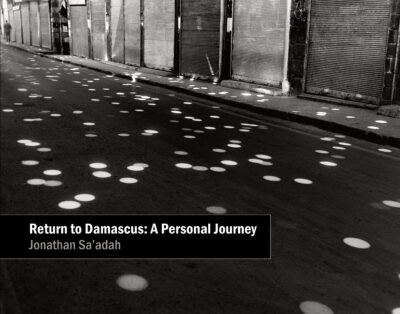
A Personal Journey
Jonathan Sa'adah
$39.50
172pp
9781927496213
Horizontal spreads portray the organized chaos of Damascus street life. A boy runs across the edge of the frame. Street-side bakeries, crowded newspaper kiosks, and lively shop scenes keep time with the rhythm of life. Light dapples the corridors of ancient souks and minarets puncture the horizon line, while political propaganda posters and exposed rebar hint at the tensions that simmer just beneath the surface.
The second section, “The Crescent Protects the Cross,” constitutes a further historical reaching back, shifting to an account of sectarian violence that broke out in Syria in the 1860s between Druze, Muslim, and Christian communities. Sa’adah honours the Algerian revolutionary, Abd el-Qadir, for defending the Damascene Christian community at the time, crediting him with saving his own family, and revering him as “a universal symbol of humanitarian values and interfaith solidarity.” The photos in this section depict scenes of interfaith reality: women pass through the frame wearing hijab, niqab, or no head covering whatsoever. Neighbourhood men play a raucous game of street soccer. Sheets hang in an empty courtyard. A toddler waddles across the wide sahn of Umayyad Mosque. The work here also takes on a more personal dimension, with photos of Mounir Sa’adah in a Christian church and at the family tomb.
“Out to the Qalamoun,” the third section, outlines their journey beyond Damascus to Ma’lula and Seidnaya, reaching back further to ancient Christian villages where the inhabitants still speak Western Neo-Aramaic, the language of Jesus Christ. Sa’adah again emphasizes the history of religious coexistence in the region, where both Muslims and Christians share Aramaic identity and the divine appreciation for the same Christian iconography. The photos here depict biblical landscapes, homes stacked like building blocks against cliffsides, ancient Christian caves, and expansive views of Our Lady of Seidnaya monastery backed by modern concrete construction in the village beyond.
In “Returning to the Heart of Memory,” Sa’adah closes the book with personal reflections on his journey. His father’s Damascus has become unrecognizable to him in many ways, yet there is an “essential spirit” that carries across generations. Sa’adah shares his faith in our capacity to transcend religious intolerance, and embrace the “complex mutual recognition of the sacred,” while expressing his concern for the delicate balance in the region. (As we know, chaos and violence would return to Damascus with the Syrian Civil War in 2013.) The final photo in the book – a lone olive tree standing defiantly in a desert landscape – communicates this “essential spirit” better than any words. For Sa’adah this has not only been a journey towards personal identity, but also a reaching back, towards something greater within all of us.mRb

0 Comments