


What better title than There’s Always More to Say for a collection of stories by a debut author who, presumably, is just getting started. In nine discrete tales, Natalie Southworth weaves the difficult topic of mental health with ordinary experiences of everyday life, told mainly from the perspective of an adolescent. She writes with compassion about characters who are suffering, individuals and families as a whole, blaming no one for the damage that is done but detailing how everyone is affected. Taken together, there is a sadness to the collection, a sense of failure or regret at our inability to protect the vulnerable, especially children, from the shattering and consequential episodes that go on to define their lives.
There’s Always More to Say Linda Leith Publishing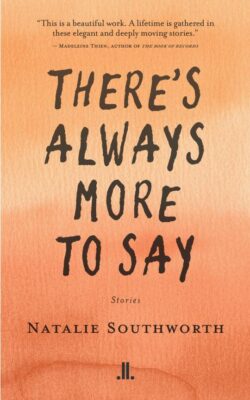
Natalie Southworth
$26.95
paperback
170pp
9781773901862
Southworth writes evocative sentences, and there are keen observations throughout. In “The Realtor,” when a man can’t make a go of a second career and his wife is pleading his case to his boss, the image of a downtrodden man appears vivid and alive: “All he could do was stand there, arms at his side. His shirt was wrinkled down the front along the buttons and his brown dress pants were baggy at the knees. It looked like he’d been unpacked from a suitcase and set up into a standing position.” In “Spectacular,” when a classmate becomes obsessed with the emaciated body of an anorexic girl, harrowing descriptions are woven into the narrative: “Fiona’s spine could’ve been a pasta tong that was trying to bore through her skin”; “I could see the notches along her shinbone protruded like the bumps in peanut brittle”; “Her chest bones were ripples on a dead lake.” More than unsettling, these sentences convey the perverseness of the fascination, and the harm done by onlookers, including parents, who watch from a distance and do nothing.
Variation in structure, voice, and context is less evident in this collection than might be expected. All the stories unfold in similar settings, featuring characters with similar backgrounds: secular, middle class, urban Canadians who likely grew up around the same time as the author. Often, near the end of a story, there is a narrative leap forward of several years or decades, which becomes somewhat predictable. But read at intervals, none of this detracts greatly from a formidable debut collection. The question that lingers when the last page is turned is the one that was hinted at from the start: What else does Natalie Southworth have to say?mRb

0 Comments