

It’s good to be reminded, from time to time, that every life is as alive as the imperious flicker of our own, as is done in Together by the Sea, tragically, beautifully, and if you hear this review in your head, speaking itself between commas into vast, unending consciousness, know this is an attempt to bring you closer to the work of Marie-Claire Blais, a writer known sometimes for writing entire novels with just one protracted sentence, likened often to Virginia Woolf, and known always for her incisive, original language that displaces its usual conventions.
Together by the Sea House of Anansi Press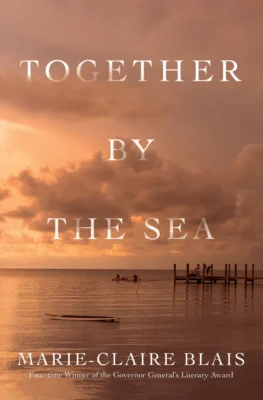
Marie-Claire Blais
Translated by Katia Grubisic
$24.99
paperback
256pp
9781487006358
That this novel is written in unending lines peppered with commas – that the first period appears four pages in – is an approach to language one might expect to be dense or difficult to consume. Rather than focusing on following exact plotlines, it is more important to follow the themes of the novel, to empathize with the many interlocked perspectives, and to allow the writing to wash over your mind, as you would the ocean over your feet. Trust me that once you settle yourself into that period-less rhythm, which may require a dozen or more pages of patience, the experience of reading will become so smooth, so immersive, as if something has overtaken your mind and you feel truly in tune not only with the writing, but also with the entire human experience.
In our current age of identity politics, it may seem all the more bold for a white woman author to create a narrator who inhabits so many disparate characters with ease and seemingly little reservations, from Black trans sex workers to Nazi doctors. The narrator is a kind of omnipresence who slips in and out of different minds, maybe parasitically or possessively, but more so passively, voyeuristically, empathically. The result is something overwhelmingly genuine and comprehensive, that proves its commitment to the idea of humanity as a shared experience. Together by the Sea will likely bring you a better understanding of the acutely contemporary life all around us, but it may also bring you to tears as it does so – not necessarily through its glittering language, nor through its cascading narrative work, but through its unflinching representation of reality that may bring you to recognize life for its depth and fragility.
This work is meant to push past limits and ends, long-winding but not long-winded, until it does end, 219 pages past the start, at which point the entire Soifs series ends too, ten books in. The last forty pages present an immensely tragic apex before moving on swiftly to celebration and happiness. “This book you’re writing is the most lyrical, the most beautiful, it’s almost too cryptic,” says one character, Frédéric, to another, Charles, in the book’s final section, “perhaps the lesson of hope is too transcendental for your readers.” We can only hope Together by the Sea, with its musings on life, so alive, fleeting and too grand, on human violence and wrongdoing, on privilege and defensiveness, on disintegrative and integrative humanity, the happy and the trusting, the insular and elitist, is not too great a lesson for us. It may break your heart, or it may help you understand what is broken around you already, or it may only make you pause for a moment, that is, if you allow it.mRb


0 Comments