

Robyn Sarah’s first collection in ten years, We’re Somewhere Else Now, marks a return to a voice both familiar and probing. Her poems carry an ease of camaraderie, a voice to commiserate with, lightly: “Winter is here once more,” she writes; “(What were we expecting?)” she whispers. That delicate balance of intimacy and observation extends to the book’s meditative closings: one poem ends, “and to see, and to see, and to see,” which reminded me of Julian of Norwich’s refrain, “and all shall be well, and all shall be well, and all shall be well,” a sense of comfort even amid the slow creep of a decaying world.
We’re Somewhere Else Now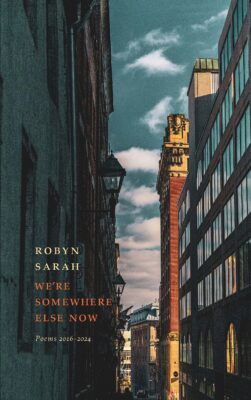
Poems 2016-2024
Robyn Sarah
The collection opens with the first section, “Once More,” thirty-one poems of impression and tempered expectation. In the second section, “In the Wilderness,” subtitled “A Soliloquy, in broken time,” the register shifts, exploring the dislocations of contemporary life, adopting occasionally the voice of inquiry and philosophical reflection: “We open our eyes at birth to the oneness, but when we begin to see, what we see is separation. We learn the world by separating things we see.” These reflections are tempered by a grounding insistence on attentive perception: “No ideas but in things / No answers but in questions.”
In this way, Sarah’s poetry makes attempts at closure but finds only doubt. Sarah envisions doubt in multiple forms: as condition (“I am; there I doubt”), as character (“a tall, lean, androgynous fiddler”), as thrall (“in the sway of bare branches in the wind”), and as self (“I had become Doubt”). By the collection’s close, doubt is neither fully resolved nor conquered; it remains a presence through which the speaker learns to inhabit complexity and see clearly without insisting on certainty: “Doubt can kill faith. But it can also / give birth to it. A paradox.”mRb
0 Comments