


We love a lone genius, but how many discoveries are truly the work of one person? The Mind Mappers, by Eric Andrew-Gee, is the story of one such dazzling genius, Wilder Penfield, and the man in his shadow, William Cone.
Cone and Penfield’s careers saw neurosurgery progress from a dark period that had hardly moved on from blind trepanning to a stunning illustrated cartography of the brain, but it’s the pair’s friendship that forms the core of the story. The two are complementary opposites; Penfield is the showman, charming the public and the medical community alike. He laps up recognition for his pioneering epilepsy treatment and the development of the world-famous Neuro Institute in Montreal. Cone, on the other hand, shies away from the spotlight, quietly working with Penfield to develop the Neuro Institute and innovate in the less sexy, but vital, fight against infections in surgery. Andrew-Gee wrestles Cone out of hiding to reveal how Penfield’s greatness was only possible with the gruelling work of his “useful” friend.
The Mind Mappers Penguin Random House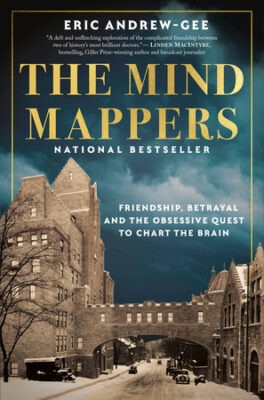
Friendship, Betrayal and the Obsessive Quest to Chart the Brain
Eric Andrew-Gee
$38.00
paper
368pp
9781039008069
The Mind Mappers is, in a sense, an autopsy of a friendship, a hunt for the root cause of Cone and Penfield’s differences. The author dissects how differing personalities, miscommunications, and ambition can unravel the strongest of friendships. Even in the happiest moments of Cone and Penfield’s friendship, we are reminded that the story of these two star-crossed heroes will end in tragedy. Andrew-Gee admires both men greatly; even their flaws are described generously. They had excellent bedside manner and frequently took patients who couldn’t pay for their world-class care. The two men seemed blind to the prejudices of their time, hiring women, people of colour, and even French speakers. Only briefly do we glimpse Cone’s moodiness and habit of overworking his residents, or Penfield’s self-absorption and willingness to leave the hard work to other people. The author reserves his harshest critique for Penfield’s betrayal of his loyal friend Cone.
It’s easy to understand Penfield’s motivations, as he left behind reams of diaries, speeches, and books that unpack every thought that went through his head. By contrast, Cone barely wrote anything down. Andrew-Gee seems bewildered by Cone’s unreciprocated loyalty to Penfield, most apparently in his ponderings about Cone’s sexuality. There is some circumstantial evidence suggesting that Cone was a closeted gay man: his close friendship with a hospital orderly, his difficult home life, and hints of a secret that horrified his former mentor, Samuel Orton. However, Andrew-Gee takes his speculation further, suggesting that Cone’s undying loyalty to Penfield and eventual distress at his betrayal stemmed from unfulfilled romantic yearning. This conclusion feels like a stretch of already thin evidence.
The motivations behind Cone and Penfield’s complex friendship is impossible to fully untangle, like most relationships. However, their battle to map the uncharted territory of the brain is a truly incredible story. The Mind Mappers draws a fascinating image of the early days of neurosurgery, illustrating that it takes many minds to understand the brain. mRb


This is an illuminating and well-written review.
16Mar2026
I read this wonderful book review just today, but read the book in July2025. I enjoyed both ommensely. The book was the best book I had read all year; this was partly due to the fact that I have worked as a medical resident at the MNI in 1962; after Dr Cone had died. But the stories about Dr Cone were alive and well at the MNI.
The book review by Iona McEwan is just absolutely beautiful and perfect in every way!