


My first impression of Cornelius: The Merry Life of a Wretched Dog was uncanny in a bodily more than literary sense. Like the sensation of missing a stair or connecting a spoonful of food with your cheek, I stretched out my hand to accept the book and my whole arm sank under its weight. The emotional texture of Marc Torices’ graphic novel is similarly familiar and surreal, an unsettling combination that is also very funny. Cornelius, the protagonist – as well as the main character of his own universe – is a dog languishing under the full weight of a human psyche; an aimless, ambitious, creative type; janitor by day, writer (it is ultimately decided) at heart. It more or less follows that an over-active inner life is core to Cornelius’ being.
Cornelius Drawn & Quarterly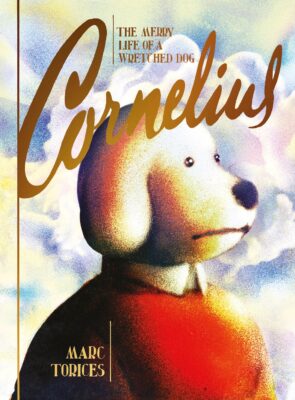
The Merry Life of a Wretched Dog
Marc Torices
$49.95
paper
392pp
9781770467767
Across Torices’ various drawing styles, characters change in appearance and remain believably themselves. It’s a playful approach to capturing a social order driven by soul-searching and insecurity, the distinctly cowardly Cornelius. Splicing between inner thought and outer reality, present tense and memory, Torices applies the seriality of comic strips and the form’s sequential panelling to cinematic effect; the narrative is engrossing. After witnessing the kidnapping of his friend Alspacka, and meddling with her ransom, Cornelius’ luck suddenly turns. Desperate to rewrite, repress, and succeed at any cost, he spirals. Channelling this delirium, the story transforms erratically. Shorter strips pop up like intrusive thoughts. Where once they seemed to spell it out in shining lights, title panels now chant his name like evidence of its worthlessness.
Before and after the kidnapping, Cornelius goes to work at the Turbo Diesel Club gym, tries to keep up with the cultural scene, and talks about unrealized projects. Though it is governed by the logic of dreams, and sometimes benders, and contains instances of straight absurdity, his story is at its core slice-of-life. Sometimes uncomfortably so, if you belong to a similar demographic of lost youth. At face value, it’s odd to try and reconcile the fantastical world of the prologue, in which “Cornelius has prevented… war – and triggered others” with a character who, exposed by an underhanded comment, spends his days “hubristically fantasizing about the… future [while] loafing around.” Then again, as the book makes plain, self-mythology is a very powerful thing.
With Cornelius, Torices offers a perfectly ambivalent tribute to the sheer force of the creative ego, never losing sight of its signature inertia. The book is also a strong argument for the medium’s ability to spin human contradiction and the everyday with the insight and intrigue of a novel. Cornelius is a lot of things, infectious among them. Having really enjoyed the book, I’m conscious of slipping into Cornelius-like hyperbole. Taking my cues from Cornelius, I’ll forgive myself, because as the prologue explains, one “either detests him or finds him delightful.” mRb

0 Comments