


Much like its eponymous protagonist, Heather O’Neill’s latest novel Valentine in Montreal is dreamy and comforting. In each of its chapters (originally serialized in the Montreal Gazette) we are plunged into the world of Valentine, a girl who inhabits a magical realm inside the Montreal metro. Although she is twenty-three years old, Valentine has had no formal education and seldom wanders beyond the Montreal underground – her musings could just as well be those of a young child or an aging woman. We first meet Valentine at Berri-UQAM, where she works at the station’s dépanneur with her irresponsible co-worker, Barney. One day, Valentine spots her doppelgänger on the station platform and decides to follow her. The young woman leads Valentine on a wild chase through the city, during which she is threatened by the mafia, meets a world-famous composer, and attends the premiere of her lookalike’s ballet.
Valentine in Montreal HarperCollins Canada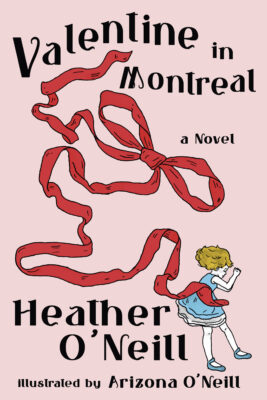
Heather O'Neill
Illustrated by Arizona O'Neill
$29.99
hardcover
224pp
9781443475259
Some of the book’s magical elements, however, verge on being unnecessarily exoticizing. For instance, the musical arrangements of composer Bela Belizima are alleged to have mystical properties. In her youth, Belizima disappeared for seven years, returning with a series of concertos adapted from folk music stolen from people she met during this time. In Bela’s stories, Berlin and Paris are painted as large urban centres with national symphonies, while major cities in Eastern Europe – Romania, Hungary, Poland, Ukraine, Bulgaria – are populated with “peasants” whose folk music she appropriates. Most of O’Neill’s antagonists are also based a little too heavily on stereotypes of Eastern European immigrants: none of the novel’s protagonists’ ethnicities are mentioned, yet the overtly misogynistic gangsters in the story are explicitly said to be Russian. In this book, chock-full of characters enchanted by aquatic animals that swim around in the mosaics of different metro stations or living in houses where “the wallpaper changes,” it seems plausible that readers’ suspension of disbelief could have extended to include superstitious villains and magical symphonies without relying on outdated exoticism.
This minor issue is nevertheless easy to overlook in an otherwise charming novel. O’Neill has managed to capture the experience of serialized reading for her audience. Each section is titled after a metro station and immerses the reader in a playful world they’re eager to revisit, with chapter endings that leave them wanting more. Arizona O’Neill’s illustrations add wonderfully to the story, never portraying quite what one expects them to. In this way, they do not simply accompany but enrich, and it is clear that mother and daughter worked together to create this bewitching world. I highly recommend this lighthearted novel to anyone who enjoys riding the metro, laughing out loud while reading, and pasting together newspaper clippings.mRb


0 Comments