

Since moving to Montreal “temporarily” in 2022, I’d lived with the idea of elsewhere as a hazy inevitability. Whereas I related mindlessly to the particulars of leaving, my resolution to stay felt like waking up to my surroundings. I tuned in, and suddenly I was attached. Reading Strangers Need Strange Moments Together shortly afterwards, I came to recognize this experience as a very literal case for the emphasis author-collaborators Mouna Andraos and Melissa Mongiat place on presentness as part of what bonds us, meaningfully, in and with our cities. The book revisits fifteen years of public activations by Daily tous les jours, their Montreal-based interdisciplinary studio, that (to oversimplify) works across interactive design, urban planning, and public and participatory art. To borrow characteristically whimsical phrasing from the book, Andraos, Mongiat, and their team aim to build local “infrastructure for the human spirit,” revitalizing the basic but timeless principle that our realities are always subject to shifts in perspective.
Strangers Need Strange Moments Together Set Margins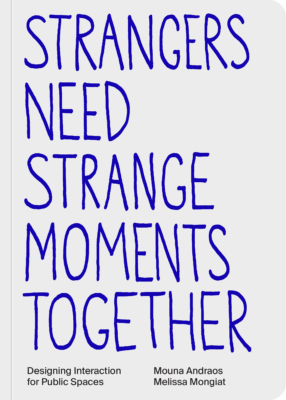
Designing Interaction for Public Spaces
Mouna Andraos and Melissa Mongiat
$45.00
paperback
240pp
9789083449852
Strangers is uncomfortably sincere at times. At its best, though, the book’s combined account of playful ideas, social research, technical knowledge, and commitment to public interest reads like listening to someone discuss something they’re uniquely passionate about. In these moments, it is life-affirming, almost independently of the Daily tous les jours projects it describes. Equally fun to read are the little gems of inspiration strewn throughout the book. Andraos and Mongiat refer hopefully to examples of successful public engagement initiatives by others working across disciplines. They also acknowledge the curious cues their own projects have received, from sources spanning international cinema to pop music, and lessons from the social dynamics of pigeons at the park. In the face of the need for more humane and connected cities, who’s to say the most promising solutions won’t come from Monty Python? Occasionally undercut by the book’s unselfconsciously celebratory tone, Daily tous les jours’ willingness to see the wisdom in the weird suggests genuine humility as much as it does optimism.
This ethos is also conflicted by the book’s appearance (its cover in particular), which skews more corporate quirky than truly strange. I mention it because by contrast, the artistic concerns of the playful constructions it describes feel quite substantive. Any practice that claims ethical and aesthetic ambition in the same breath asks to be treated cautiously. Importantly, Daily tous les jours’ mission is, at core, material – each project a practical experiment aimed at realizing better ways of living together. At the same time, it resists wholly utilitarian terms not just because it hinges on disrupting efficient patterns but, crucially, because it rests in respecting what Strangers articulates as the ineffable, poetic, and undesignable character of cities, and the human relationships they bring to life.
The jauntily coloured surfaces of Daily tous les jours’ projects further characterize this heartfelt philosophy, each earnestly expressing a variation on the logic that “It is very hard to be angry, stressed, or sad while gliding on a giant pink parasol.” This is at least as charming and intelligent an integration of form and function as any. It’s also probably true.mRb
Hey Montreal (and rest of Canada!) the book is available here with cheaper shipping: https://www.booksellers.ca/books/strangers-need-strange-moments-together-designing-interaction-for-public-spaces-9789083449852