

I tripped over the title of Carlos A. Pittella’s latest chapbook the first time I read it. What is a propersition, exactly? At first glance, it might seem like a slip of the tongue, or a trick on the eyes. But the word carries echoes of propriety and position, and traces of prepositions and propositions: terms of situation, alignment, and exact placement. Pittella seizes on this cluster of meanings to ask what it means to be (dis)located in both language and life.
propersitions Cactus Press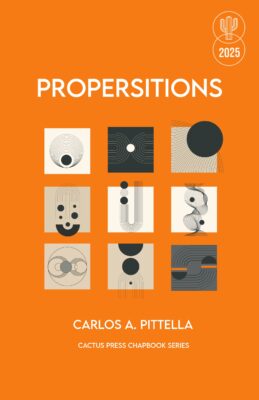
Carlos Pittella
$10
paperback
9781990474408
The chapbook is recursive, circling its images – walls within walls, “the tides within the tides” – as though testing the limits of language’s capacity, poetic or bureaucratic, to hold experience. The poems move like a mind caught between thresholds: visas, borders, permissions, refusals, evictions, and the empty space left by a chipped tooth. They track how borders attempt to mediate our ability to understand ourselves as situated, and how surveillance attempts to reduce us to something improper. Yet at the same time, they open into moments of brilliant lyric suspension: “Suddenly all greens look green—you take photos / of subtle branches to remember left or right?” mRb
0 Comments