


Dr. Colin Ripley deconstructs the tenets of architecture in his most recent book The House Is (Not) a Prison: On the Queerness of Architecture with the argument: to be queer is to be anti-architecture. This perspicacious text reads remarkably fast, offering an intellectual yet sufficiently relatable exploration of the structures that shape our modern daily living. Ripley welcomes readers with a researcher’s quest via interview to unearth the lore of Lucien Sénémaud’s house in Cannes (designed and gifted by the trailblazing queer author Jean Genet) while integrating throughout, and thereafter, a panoply of literary and cinematic works. In Slavoj Žižek’s foreword of the book, he references (the ironically named) Ripley’s Game by Patricia Highsmith, stating: “what Highsmith achieved in her domain, Colin Ripley did for queer studies.”
The House Is (Not) a Prison Concordia University Press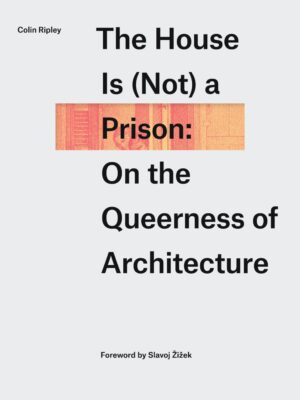
On the Queerness of Architecture
Colin Ripley
$49.95 CAD
Paper
368 pp
9781988111612
While a house is often a symbol of comfort and familiarity – with “home” as something wholesome, warm, and welcoming – Ripley delves into the less picturesque ideas of house as erotic machine, of domestication as imprisonment, and a number of perverse iterations a house can assume. Hardly novel concepts, admits Ripley; he names the evident and hackneyed comparisons of queerness to architecture through metaphors such as the “closet” for repression, and the role of Philip Johnson’s Glass House for the “ambidextrous character of the screen, its simultaneous ability to hide and display.” Naturally, he draws also from Michel Foucault’s “heterotopia” in addition to Discipline and Punish on the all-surveiling essence of Bentham’s panopticon “as a diagram of power… although admittedly without its architectural trappings and circular plan form, as central to our contemporary world.” These are all helpful and necessary contexts for situating a new reader outside of the field(s), easing them past the threshold of an eclectic and enlightening mid-twentieth-century canon, guiding them into the territory of “suitcase as the microcosm of a house” with a focal point on Genet – as rings true for much of the book. Segments from Derrida on map-making, as well as Lacan’s observations of the relationship between architecture and voids, are also interspersed throughout.
Ultimately, The House Is (Not) a Prison is a scholar’s playground, dense in parts and chock-full of foundationally queer theoretical frameworks, carefully laid out and dissected through the lens of an architectural researcher and designer. The book itself swerves between its myriad themes in its own fascinatingly profound rhythm of chaotic order, rendering it a most useful and bountiful resource across an expanse of sociocultural knowledge, laying the impressive groundwork for, as Ripley writes, “ways of thinking and building that desperately resist the utopic in all its aspects.”mRb


0 Comments