


For a stand-up comic, things in Louis’ life aren’t very funny. Jean-Christophe Réhel’s All Kidding Aside takes place in the suburb of Montréal-Est, where protagonist Louis slogs through the snow on Sherbrooke to his job at the Pointe-aux-Trembles Tim Hortons, and at home takes care of both his father (terminally ill with glioblastoma) and his brother Gui (twenty-eight years old, schizophrenic, and a disciple of Eminem).
All Kidding Aside QC Fiction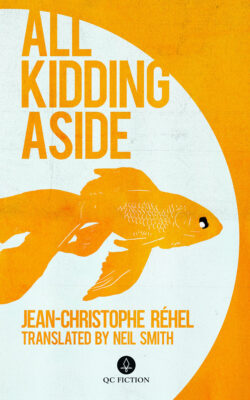
Jean-Christophe Réhel
Translated by Neil Smith
$24.95
paperback
306pp
9781771863803
Louis’ candour and self-awareness are the engine of this novel – a novel which, against all odds, is actually quite funny. While admittedly the situation is bleak, as in Réhel’s previous work the landscape is one lighted by its characters, all of whom feel whole and developed unto themselves. Rapid-fire banter is expertly rendered by translator Neil Smith (with an explanatory note on Quebec profanity for the uninitiated), and despite everything stacked against them, the little family shares moments of genuine happiness in what Louis thinks must be the crappiest three-bedroom in all of Montreal.
At the same time, the novel avoids falling into oversimplifications or silver-lining platitudes, and the challenges its characters face are real. The author of three novels and six collections of poetry, Réhel has a sensitivity to nuance indicative of his training as a poet. Concise, unflinching, and often circling back on understated prior details, the short vignettes comprising All Kidding Aside have the power to stand on their own, showing Réhel’s aptitude for succinct forms even in prose.
Réhel’s attention to nuance is especially important in his treatment of mental illness. While in the past Réhel’s novels centred characters with cystic fibrosis (a condition with which the author also lives), All Kidding Aside instead deals with schizophrenia, an illness to which Réhel’s own relationship is not clear. The novel seems actively engaged in confronting Louis’ own assumptions about his brother, who is often observed by Louis as childlike – “a twenty-eight-year-old kid with neck tattoos.” Indeed, at various points Louis has to shake himself from treating both his ailing father and brother as children. The difficult balance between his responsibility as a caregiver (albeit an imperfect one), and his desire to respect his brother’s autonomy is one of the bittersweet impasses of the novel, culminating in an ending that feels almost Steinbeckian (perhaps not coincidentally, Louis and Gui share their initials with the protagonists from Of Mice and Men).
Though fast-paced and punchy, All Kidding Aside manages to explore serious moral dilemmas without being prescriptive. Like a good joke, like a good poem, its impact resounds beyond its last line.mRb


0 Comments