


I remember doing some writing for a nebulous fashion magazine in Montreal in the early 2000s – what seemed like a boom time, but was really the beginning of the end of the old media age. The publishers appeared to have more money than sense, but when it came time to get paid, they were notably evasive. Eventually an insider tipped me off that my best bet was to come to the office in person. There, someone sweetly explained that they hadn’t received my invoice – despite the presence of a cheque made out to me sitting right there on the reception desk. This was not my first, nor last, reminder that certain companies (and individuals) will take any measures they can to delay, or outright avoid, paying their contractors. (A certain sitting head of state built an entire career on it.) Every freelancer knows this, but only Raymond Biesinger has written a book about it.
9 Times My Work Has Been Ripped Off Drawn & Quarterly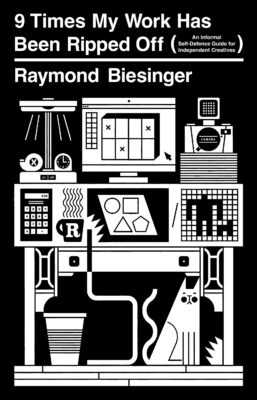
An Informal Self-Defence Guide for Independent Creatives
Raymond Biesinger
$22.95
paperback
200pp
9781770468016
The subtitle, An Informal Self-Defence Guide for Independent Creatives, reminded me of UdeM professor Normal Baillargeon’s 2005 A Short Course in Intellectual Self-Defence. Baillargeon urged readers to engage in critical thinking and confront logical fallacies; Biesinger is more interested in action – specifically, the actions necessary to get compensation for one’s work. In each instance, Biesinger recounts the steps he took – elaborate plots, clever schemes, and occasional truth-stretching ruses – to get paid.
Biesinger’s roots in the punk scene are evident in his tone – sometimes angry, always direct and to the point, at times recalling the writing style of the late recording engineer and punk polemicist Steve Albini. But while Albini had a misanthropic core, Biesinger has a bit more kindness behind the scowl. He often gives the benefit of the doubt to his antagonists, or acknowledges that he can see where they’re coming from. He writes towards the end of the book that “we should also remember to forgive and to be generous, especially when we’re dealing with people similar to our flawed little selves.”
Only towards the end of 9 Times My Work Has Been Ripped Off does Biesinger briefly address the topic of AI, perhaps the greatest creativity heist of all time and certainly an ominous and immediate threat to freelance creative workers. No doubt many books have addressed the social impact of AI; the situation might be enough to make us pine for the days when human venality was our biggest problem.
Talking about money is widely considered uncouth, especially among the (supposedly) morally untainted underground/DIY community from which Biesinger springs, so he deserves credit for his honesty and transparency about a delicate subject which many would prefer to keep discreet. Decorated throughout with Biesinger’s stark but vivid work, the book is mainly aimed at illustrators and designers. But its lessons apply to any freelance creative workers and the self-employed in general, who really need his kind of backbone to survive in the Darwinian capitalist jungle we inhabit.mRb

0 Comments