


I can’t remember when I became captivated with the Eastern Townships, but I know why.
It was the space cannon.
Gerald Bull was once the world’s leading artillery expert. In the mid-20th century, when rockets first became capable of putting satellites – or something more sinister – into space, artillery must have seemed decidedly old hat. But Bull understood something very important: artillery and rocketry both involve metal tubes directing explosive energy to send projectiles (or payloads) over considerable distances.
Bull sent some of those projectiles across an expansive crossborder testing range in the Townships. But while designing advanced artillery systems made Bull a wealthy man, his true passion was using artillery to launch satellites into space.
Saddam Hussein gave him that opportunity when he wanted an Iraqi space program. The Mossad worried about the payloads a space cannon could launch over Israeli territory. Gerald Bull was found dead in his Brussels apartment in March 1990.
Quebec’s Eastern Townships and the World McGill-Queen's University Press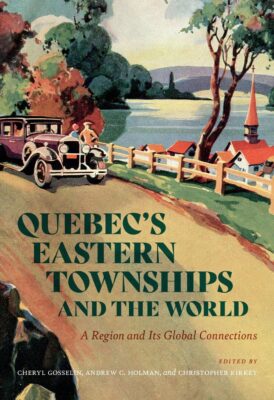
A Region and Its Global Connections
Edited by Cheryl Gosselin, Andrew C. Holman, and Christopher Kirkey
$32.95
paperback
438pp
9780228023586
There’s a fluid quality to the Townships’ geography, not least because it isn’t an official administrative region of Quebec, and the English-speaking population that settled it has been in decline since before Confederation. The fluidity of the boundaries reflects the transitional nature of the region itself: it is both a borderland and a bridge between languages, cultures, societies, states, and nations. This transitional space can have transformative qualities. As Gordon S. Barker and Christopher Kirkey explain, it was in the Eastern Townships where ex-Confederate president Jefferson Davis – who sought reinvention and a return to wealth and status – instead transformed into a dependent, surviving off the charity of others.
Jane Jenson explores the other side of that coin in her chapter “Border Crossing Enlistments during the Civil War.” Between 35,000 and 50,000 Canadians participated in the conflict, though most were living in the United States when war broke out. Jenson examines the phenomenon of Canadians crossing the border to volunteer for the Union. That such volunteers would come from the Townships is hardly surprising, given the historic fluidity of the international frontier. Jenson notes, however, that the line had hardened from the Loyalist era, with events such as the War of 1812 and the Rebellions of 1837-38 doing much to solidify the distinctness of proto-Canadian identity. Moreover, elite Canadian opinion tended to be sympathetic to the Southern cause. Jenson suggests that, whether as a consequence of transnational labour mobility or equally transnational religious communities, volunteers from the Townships may have felt the conflict was “at least partly theirs.”
The book is divided into four sections. Part one, “Space and Place: Making the Eastern Townships,” concerns the construction of identity, how local and international forces shape the physical expression of the region. Essays in this section discuss the resilience of Abenaki place names, why settlement projects in the early nineteenth century failed to transform the Townships into a distinctly British region, and how changes in agricultural practice contributed to the region’s emergence as a leader in sustainable development.
Part two, “Peoples in Motion: Moving Into and Out of Quebec’s Eastern Townships,” focuses on human mobility. Among the five essays contained here, the first examines the traditional movements of Indigenous populations through Ndakina, the Abenaki word for their ancestral homeland, and how European colonization upended this movement. Another considers the experience of Eastern Townships women who trained as teachers at the Montreal Normal School. The two essays concerning the region’s connections to the American Civil War are also contained here. The final essay examines the contemporary immigrant experience to the Eastern Townships.
Part three, “Institutions, Local Identities, and Global Connections,” considers cross-border schooling in Quebec and Vermont, and the Townships’ considerable print news media in the period between Confederation and the Second World War. This section contains an illuminating chapter on Bishop’s University’s connections to the residential schools, as well as Sherbrooke’s mid-twentieth-century spell as a top-tier venue for major contests in the world of professional boxing. The section concludes with an assessment of the Townships’ contemporary religious landscape.
Part four, “The Eastern Townships as an Imagined Place and a Global Commodity,” considers how the Townships are interpreted by writers, artists, and photographers seeking to connect the region with the broader world. This includes essays on contemporary fiction set in the Townships, with a particular focus on deindustrialization, and on how postcards from the early twentieth century presented the Townships to a global audience as both an idyllic refuge and a resource rich area ripe for exploitation. The concluding essay focuses on the work of author Louise Penny, whose Inspector Gamache novels have brought the Townships to an international audience.
Though Quebec’s Eastern Townships is an academic text meant to highlight new research, it covers a diverse range of interesting subjects presented in an accessible style. Covering a broad timescale, it includes underappreciated histories as much as contemporary considerations. The authors make a compelling argument that the Townships’ distinct character is a consequence of its rich history of global connectedness.
The Haskell Free Library and Opera House typifies this global connectivity, to say nothing of the region’s rich cultural foundation. Deliberately constructed on the border, the edifice has long been a symbol of good relations between neighbours. The scholars who contributed to Quebec’s Eastern Townships likely couldn’t have imagined that the second Trump administration would view it as demonstrative of an apparently porous border. Nor might they have imagined annexation threats and a trade war. This unfortunately may signal a new chapter in Eastern Townships history, one in which cross-border cultural and economic exchange is severely constrained.
Hopefully this doesn’t last, but for as long as it does, Montrealers may wish to reacquaint themselves with the Eastern Townships. As Michael Goldbloom relates in his foreword, the bonds of community that make the Townships work offers a guiding light for Montreal, Quebec, Canada, and beyond.mRb

0 Comments