


Who are the people who die waiting? Other Endings: Organ Transplantation and the Burdens of Hope dissects this question – one the author, Anita Slominska, finds scribbled in the journal of her older sister, Shauna. From the opening pages, we know that Shauna is one of those who died waiting for a life-saving liver transplant. Yet at just twenty-nine, her death comes as a shock to her family and friends who had held on to hope that she would receive the call.
Other Endings McGill-Queen's University Press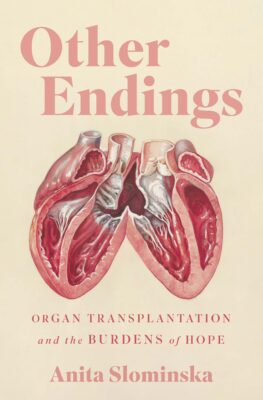
Organ Transplantation and the Burdens of Hope
Anita Slominska
$24.95
paperback
180pp
9780228027195
The happily-ever-after transplant story told to everyone with a donor card doesn’t make space, Slominska argues, for those who die waiting. She writes how “[o]ur knowledge and understanding of organ transplantation is limited to this ‘imaginary’ version that posits transplantation as a rebirth.”
A question that lingers for me as a reader (and friend to a transplant recipient): While Slominska is not arguing against donation itself, how will transplant advocacy groups, and transplantees themselves, respond to a book that challenges the core messages – hope and celebration of the gift of life – on which public support for organ donation depends?
The book’s most unsettling moments emerge from this tension. Recalling Shauna’s physician’s wish that somewhere someone might suffer a “gunshot wound to the head” so that a viable liver could become available, Slominska reminds readers of the uncomfortable reality that transplantation depends less on generosity than on tragedy and social inequity: “Optimal donors are young and often die violent deaths, and there is no escaping recognizing that this is connected to a system of economic and social injustice, racism, and also mental illness,” she writes.
While grounded in critical theory and medical anthropology, Other Endings ultimately belongs to a tradition of mortality memoirs that includes Joan Didion’s The Year of Magical Thinking. In that book, Didion reflects on the sudden death of her husband, John Gregory Dunne, and her grief-clouded conviction that he might somehow return from the grave. But for those on the transplant wait list, Slominska argues that an unrealistic expectation of survival is encouraged, which can prolong suffering for patients and their loved ones: “Reasons to hope now seem like a subtle form of censorship. Hope can strangle lucidity even while we insisted that it was reasonable to be optimistic […] in retrospect, it seems fanatical,” she reflects.
This is not simply a book about alternative endings, but about the stories we need to tell to live with loss. For Slominska, research contextualizes the trauma of her sister waiting in vain, while imagination offers a healing haven for lost hope: a fantasy of overturning the boardroom table where physicians conclude they have “no more tools, tricks, or magic” to save Shauna, and a posthumous dialogue with her sister about cat food and luck.
Other Endings pulls back the hospital bed curtain on the history, ethics, and limitations of organ transplantation but it doesn’t lose sight of, and it gives voice to the people, like Shauna, who lived, waited, died, and above all were loved.mRb
0 Comments