


In the spring of 2020, thousands of Montrealers descended on the Old Port stretch of the St. Lawrence to catch sight of an unexpected visitor, a young humpback whale which had somehow wandered 500 km from its habitat. This impromptu piece of public theatre, which ended in tragedy several days later, was the impetus for Whalefall, a poetic, meditative, and advocacy-driven show about the collective majesty and tragedy of whales worldwide.
Whalefall InfiniPRESS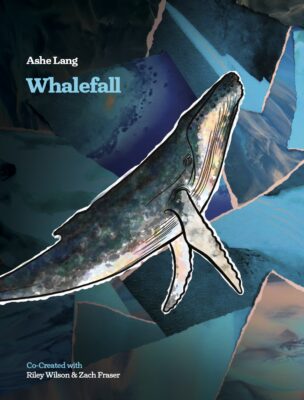
Ashe Lange (co-created with Riley Wilson and Zach Fraser)
$20
paperback
92pp
9781777873585
But this handsomely mounted sea-blue edition, the latest from Infinithéâtre’s in-house publisher, does make for an enjoyably brisk and informative read, heightened throughout by achingly elegiac passages, such as when a whale’s corpse “sinks past creatures that look less like fish and more like drowned constellations, or musical instruments peeled inside out…”
Arranged in nineteen short chapters, the script is structurally reminiscent, in its modest way, of the freewheeling, kaleidoscopic dance of form and style Melville brought to Moby Dick. As with that urtext of whale literature, poetic prose goes head-to-head with cetological data (various activists, marine biologists, and experts are interviewed), epic catastrophe with absurdist comedy. One moment we’re counting down a porpoise population headed for extinction, the next we’re swimming with orcas who have spontaneously adopted a fashion for wearing dead salmon as hats.
It’s also a coming-of-age story of sorts, as Lang touches on her own childhood obsession with whales, her naive delight in the seeming joy and friendliness of the captive animals at Marine World giving way to a recognition of the cruel realities of such places.
Conscious of her early misinterpretations, Lang avoids anthropomorphizing her dramatis personae of whales, their social, cerebral, communicatory complexities marking them out almost as aliens amongst us (and aren’t they, in a sense, extraterrestrials?).
An exception to this rule is the testimony of one of the interviewees, activist Captain Paul Watson who, having failed to sabotage a Soviet whale hunt, looked into the eye of a dying whale and read pity, not for itself but for humanity.
It seems a projection too far, yet there is a poetic truth to it; that great, lucid eye is a mirror in which we can read our own suicidal demise. A running theme of Lang’s plain-spoken text is that if the whale falls, then so, ultimately, do we.
_______________
I’m sorry to say, if only for the missed opportunity for a smooth segue, that Polonius’s “Very like a whale” is not one of the quotes referenced in Ann-Marie MacDonald’s playful deconstruction, Hamlet 911.
Hamlet-911 McGill-Queen's University Press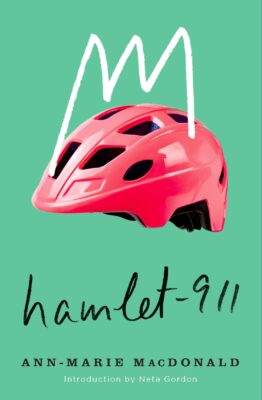
Ann-Marie MacDonald
$19.95
paperback
150pp
9780228029441
MacDonald has, of course, shown herself a dab hand both with dysfunctional family dynamics in her celebrated novel Fall on Your Knees, and with anarchic Shakespearean deconstruction in her breakthrough 1988 play, Goodnight Desdemona, (Good Morning Juliet).
In the latter, a hapless Ontarian professor is magically transported into two Shakespearean tragedies, her bemused interventions transmuting them into raucous feminist comedies. Hamlet-911 utilizes its magical portal device for a different dramatic strategy, reconfiguring the original play as a reflection of Guinness’s own life, as if, like Claudius, he’s seeing his own sins (including domestic violence) in a play-within-a-play.
Events swirl around him and play on repeat. A stage manager prompts mundane lines he’s supposed to say over breakfast. “Am I in Hell?” he wonders. If so, it’s a Dante-shaped one, and gleefully riding the concentric circles is a Yorick figure who’s part stand-up comedian, part Indigenous trickster, part Virgil-esque guide through Guinness’s dark middle-aged angst.
It’s largely a character study, then, and one might be forgiven for wondering why we should care about this rather pallid individual whose claim to fame is starring in a television sitcom called Vampire Dad.
But MacDonald’s main focus is on the social and cultural upheavals of recent years as filtered through the Canadian “court” of the Stratford Festival, with Guinness teetering indecisively between the achievements and privileges of the “old guard” (represented by the aptly named Rex, who’s both admirably accomplished and grotesquely retrograde), and his duty-of-care to a future he doesn’t understand and which will most likely leave him sidelined.
MacDonald introduces another Hamlet-figure in Jeremy, a basement-dwelling teenage fan of Vampire Dad whose tortured struggle over whether “to be or not to be” adds suicidal ideation to the play’s at times unruly swirl of concerns.
This edition includes a thoughtful if slightly dry academic introduction from literature professor Neta Gordon (it is a scholarly imprint), though she does conduct a lively interview, also included here, with MacDonald and her wife, Alisa Palmer, who directed the Stratford premiere and whose idea the play originally was.
Crucial to appreciating MacDonald’s play, and to an understanding of why this most progressively feminist of writers chose to focus on a straight white male antihero, is the context of the original production as outlined in these supplements. It was written largely as a companion piece to a Hamlet “proper” which played in the same Stratford season, and which, in a living example of the balance of tradition and progress championed in MacDonald’s play, starred gender-fluid BIPOC actor Amaka Umeh.mRb

0 Comments