

[dropcap]F[/dropcap]ree To Be More: Creative Activism in the Era of Black Lives Matter, a collection edited by Syrus Marcus Ware and Ra’anaa Yaminah Ekundayo with d’bi.young anitafrika, does not merely take the reader through a chronological roster of contemporary Black artists and activists. It traces the lineage of their survival mechanics and their absolute refusal to be contained by the grey definitions of colonial institutions.
Free To Be More University of Regina Press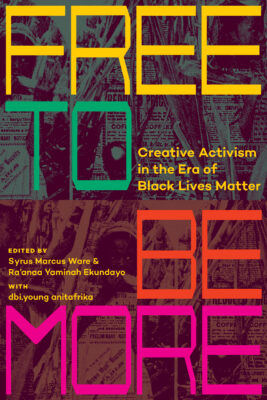
Creative Activism in the Era of Black Lives Matter
Edited by Syrus Marcus Ware and Ra'anaa Yaminah Ekundayo with d’bi.young anitafrika
$32.95
paperback
320pp
9781779401328
I found myself experiencing a profound realization when examining the book’s structural refusal to separate carceral violence from creative response. Co-editor Ware explains that the “hotbed of activists uprising” of the last decade was forged directly in response to the mechanics of carceral violence, channeling Toni Cade Bambara’s concept of “creating irresistible revolutions” to explicitly disrupt that system.
Stories of resistance, such as Kyisha Williams’ film The Zoo (2021), following a Black queer person navigating life off probation, and Rodney Diverlus’ Vakabond character, sit directly alongside the trauma of police brutality. This is a deliberate framing; as Ware notes, abolition is fundamentally about “tearing down the walls and then, over here, planting seeds for what we want to grow in its place.”
This structural rebellion acts as the ultimate mirror held up to the art world’s traditional hierarchy, which demands a manageable, trauma-fuelled asset it can audit. Ware explicitly outlines the hypocrisy of the traditional art machine, citing Susan Cahan’s Mounting Frustration, a critical examination of the art institution’s role during times of Black power, and Black liberation, to expose how museums tend to only acquire and showcase Black art during times of civil unrest.
The institution’s lack of critical engagement means these vital works are often relegated to a “side gallery off the side of the gift shop” or reduced to a “short Instagram takeover.” This recalls Fred Wilson’s Mining the Museum, which we analyzed in my Concordia art history seminars. The landmark installation juxtaposed existing historical artifacts exposing the hypocrisy, and institutional contradictions, hidden within the museum’s own collection.
Free To Be More shatters the machine of art business and art curation entirely. It serves as a necessary, self-contained counter-archive. “This is a book that is biased for us,” Ware asserts, emphasizing that it ensures Black artists maintain absolute ownership over the discourse surrounding their own brilliance.
This sovereign, independent universe is explored in jamilah malika abu-bakare’s chapter “Fugitive Sound Art,” which analyzes sound as both a method of refusal and a sanctuary of refuge. Ware praises abu-bakare’s scholarly engagement, noting how such analysis reveals the “rebellious and radical nature” of Black artistic practices. By defining sound as a wave of protection that undermines the dominant category, abu-bakare elevates the sociological weight of what it means to create space, and frequency, in an otherwise hostile environment.
This collection is not a passive visual representation. It is the sociological normalization of a community claiming its environment at its maximum potential. This embodied reclamation is echoed with striking precision in “The Art of Step,” by Kayin Queeley and Natasha “Tashe” Clery, which chronicles the history of stepping, the African-American percussive dance form, as a tool for both community building and resistance. Clery did not merely introduce step to Northern Turtle Island at Montreal’s Vanier College in 1991; she injected a radically unapologetic Black presence into an institutional space by pitching it to the school as a cheerleading squad for basketball games. Clery unmasks the hidden culture of the era, noting the profound empowerment of arriving fully geared up to set a tone the minute they walked in and made noise on the bleachers. This unapologetic presence even sparked a direct rivalry with Dawson College. Yet the institution’s failure to document this history, leaving zero VHS records, memorabilia, or written archives of the team, highlights how easily Black cultural milestones are relegated to the ether when they exist outside the dominant grey definitions.
Queeley, founder of the Montreal Steppers in 2019, traces this lineage of survival mechanics directly to the ancestral. Queeley explicitly notes that when the traditional drum was taken away from enslaved peoples, the physical body itself became an instrument of resistance. “When I go boom, boom, boom on the drum, we are planning,” he writes, describing how stepping was never just performance, but a deeply coded strategy whose stomps literally shake the ground. Queeley experienced a radical belonging when he realized his choreographic abilities, first explored in a Plattsburgh university choir in 2008 – choreographies which were not just learned, but unlocked from a path that preceded him. It is a prime example of what happens when one’s potential is fully met, existing before the world has figured out how to name or contain it.
Free To Be More shows us how the corporate structure judges and also commodifies Black presence. Queeley and Clery shatter the illusion of post-2020 institutional progress, exposing how the media heavily focused on the George Floyd tragedy while Black communities saw no financial gain and other communities grew richer. Institutions frequently offered fifteen-minute showcases without genuine monetary investment or long-term infrastructural change, creating performative five-year anti-Black racism initiatives that ultimately yielded no results. Clery points out the reality that Black lives are still utilized as the source of political pandering, while the actual wealth and pride of Black history is buried by those with the power to dictate.
The anthology continually asserts the institutional gaze by replacing it with a self-determined, highly sophisticated vision. Yung Yemi (Adeyemi Adegbesan) utilizes what he terms “remixology” and Pan-Africanist themes to navigate the dichotomy between the limitless diversity of the diaspora, informed by his own Nigerian and Swiss heritage, and the externally imposed homogeneity of “Blackness.” This same drive for autonomy fuelled the 2020 Kensington Market Black Lives Matter mural, an intervention entirely self-funded and executed by Toronto’s Black artist community. Ware pushes this subversion directly into the domestic and spatial sphere with his Activist Wallpaper Series, intentionally replacing traditional toile wallpaper, which historically depicted the white elite in bucolic scenes.
The concept of claiming absolute ownership of physical space is disrupted and reclaimed throughout the book’s documentation of local interventions. Ekundayo highlights the sociological normalization of Black resistance through Montreal’s specific actions, such as the toppling of the James McGill statue. The dismantling of this monument illustrates the power of the masses demanding change outside of traditional, bureaucratic government channels, proving that “it is the people who instigate the change.” Ekundayo traces a similarly active, unburdened belonging to the Never Was Average bilingual ground mural painted in Montreal in 2020. Witnessing that massive public declaration served as a catalyst, sparking the realization that “we can really do whatever we want.” It was a visual confirmation that Black Lives Matter is not merely an organization; as Ekundayo states, “It is a movement. It’s a battle cry. It’s an understanding.”
The creators within Free To Be More do not ask for an institution’s permission to exist. They have designed, and inhabited a brilliantly cultured, sovereign universe of their own. mRb
0 Comments