


Madeline Bassnett’s Climate Change Cookery is part historical study and part survival manual. Bassnett plunges into the archive of early modern English cookbooks, recipe manuscripts, and food science to examine how this historical knowledge can guide us in our own time of political and environmental instability.
Climate Change Cookery Concordia University Press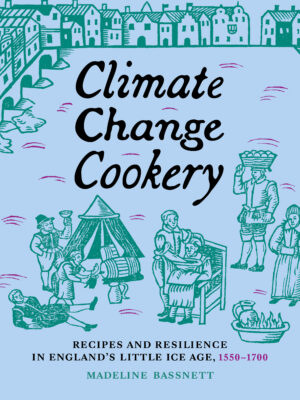
Recipes and Resilience in England’s Little Ice Age, 1550-1700
Madeline Bassnett
$29.95
paperback
218pp
9781988111681
It is difficult not to feel delight at the early modern recipes and food preparation practices as Bassnett describes a world of savoury preserves, breads made with various cultivated and wild grains, foraged herbal infusions, and pickled game meat. She recounts how women of this time kept manuscript books containing handwritten recipes that they had developed themselves or that had been passed down through their families and communities. These manuscripts are characterized as living documents which circulated between different people, who added to them not just new recipes but also “sermons, poems, letters, or sketches,” making them monuments of both collective knowledge and the much forgotten subjectivity of people from the past.
While some of the early modern recipes described in the book reflect our current digital recipe ecosystem that asks for strict measurements and a mix of ingredients at once baffling and highly specific (“Creamy Alfredo Gochujang Pasta”), Bassnett also shows the number of print and manuscript recipes that offer alternative methods, propose multiple options for ingredients, and require the cook to use their judgment and observation every step of the way. Although Bassnett describes a time when people were struggling with scarcity and precarity, it is difficult not to see this food system as something that was abundant, dynamic, and conducive to human agency.
It’s easy to get swept up in the whimsy, but this book is fundamentally about what it means to have a closer and more sustainable relationship to the natural world. The very first text that Bassnett explores is Hugh Plat’s 1596 pamphlet Sundrie New and Artificiall Remedies Against Famine, which instructs its readers on how to cook with limited ingredients (there is one recipe that only requires bread, heat, and wine) and encourages them to seek out foraged alternatives to suddenly expensive goods like wheat. Plat’s work was a direct response to an increasingly volatile natural climate and a reflection of a world in which “a majority of people worked on and with the land, encountering on-the-body weather while also negotiating seasonal patterns and changes as they attempted to raise animals and grow grain, vegetables, and herbs.” Bassnett makes it clear that this was a time when even the wealthy could not insulate themselves from the weather, could not delay acting because they depended heavily on their environment and recognized this dependence.
Bassnett’s ideas about reclaiming knowledge about food production resonate at a time when growing food insecurity coincides with record-breaking profits for national grocery chains and transnational polluters. We cannot have our means of subsistence held hostage by companies that privilege short-term profit over the well-being of our planet and its inhabitants. Although it is clear that learning how to grow, process, and preserve our food supplies can make communities more resilient and can restore our attachment to the land, there is an indignation I feel at having to prepare for an inhospitable world. While this task may be inevitable and important, I want to believe that the urgency of dealing with the present emergency should not be incompatible with demanding more for our world and for ourselves.mRb


0 Comments