


Ninan. Tiohtià:ke. Montreal.
It is the simple but perfect title for Michel Jean’s new novel, translated by Susan Ouriou, and published in English for the first time by House of Anansi.
“The stench. Always the same,” the story begins.
Ninan House of Anansi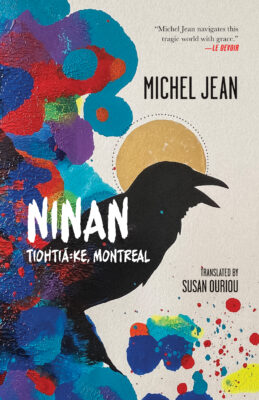
Tiohtiá:ke, Montreal
Michel Jean
Translated by Susan Ouriou
$24.99
paperback
176pp
9781487013653
In five short chapters, Élie goes from the Port-Cartier prison, to banishment from his Innu community of Nutashkuan on Quebec’s North Shore, to the 1,300-kilometre trek along Route 138 to Montreal.
“To Élie Mestenapeo, who has never seen a big city before, Montreal is both intimidating and disappointing,” Jean writes. “Intimidating because there is nothing familiar here. Everything is foreign to him. Disappointing because it is just an endless succession of anonymous buildings, dirty streets and indifferent faces.”
Those faces, however, become a community of charming, interesting, tragic, and complex people, all on paths of their own full of difficulties, tragedies, trauma, and joy.
He meets Inuuk twin sisters, Mary and Tracy Nappatuk, struggling with crack and alcohol addiction, longing for children they have been separated from; a Nakota man handing out hot meals in Cabot Square; Mafia Doc, who refuses to abandon his tent despite the cold; and Geronimo, the Cree friend who takes Élie under his wing.
“Why is it such a reflex for Indigenous folk from different Nations to seek each other out when they get to Montreal?” Geronimo asks. “Because we grew up in a community and that’s just the way it is.”
Élie is among the 1 percent of Montreal’s population: the unhoused. Indigenous people make up 10 percent of that population. Jean’s book is, however, not only an exposition of the hardships of the unhoused, but also a celebration of their resilience. The characters’ complex paths make them engaging travellers fighting addiction, pain and, in Élie’s case, a rage monster waiting to take over and inflict pain on others.
The unhoused community helps Élie survive and understand his own pain, history, and trauma. It is through this community among the millions in Montreal that Élie discovers the paths that will lead him from despair to a type of success and support that has been absent for much of his life.
He also learns to trust – particularly Lisbeth, Mary’s well-adjusted, brilliant, and successful daughter raised in foster homes away from her mother. “People trust him,” writes Jean, “something he hadn’t experienced since the death of his grandfather.”
About halfway through the book, Élie leaves Montreal to return to the land and reconnect with a buried part of himself. Through this journey, he finds pieces of himself taken by his parents’ destructive behaviour.
It is a book in three acts: Ninan (Montreal) or “the city,” the land, and then the reconciliation between the two. In the end, the paths form a circle where healing and understanding are found. The humanity in Élie’s parents – as much as they’re flawed, violent, and responsible for damage to their son – is understood. They are no more monstrous than he is. They did not, though, have the capacity, community, or resources to heal from the systemic trauma that ultimately crushed them.
Ninan: Tiotà:ke, Montreal highlights Jean’s skill as a storyteller and his talent as a journalist. He does not hide from realities, and he knows the city he investigated as a reporter. Ouriou’s translation at long last introduces English readers to the diverse and colourful community far too often ignored alongside the issues that led them to Cabot Square, a tent village on Notre-Dame, a shelter, a friendship centre or a boiler room for warmth.mRb


0 Comments