


One of the greatest pleasures of literature is its ability to transport readers to a different time and place. In Driving Crazy to the Front Door, Michael Foy’s debut collection of short stories, the reader takes a ride out west to Surrey, BC (the author’s hometown), Vancouver, Tsawwassen, Vegas, Washington state, and a few unnamed, rural locations. Salty vapour fills the air on the page; there are screeching gulls, dusty quarries, tectonic debris in urban gardens, and developers snatching up the last farms that remain on the outskirts of the cities. Paradoxically, the only story not set out west, “Hit Submit,” is the one that perhaps comes closest to capturing the mood of this collection, an awareness of our individual struggles succinctly conveyed through the protagonist’s conclusion: “Maybe we all need a fucking break.”
Driving Crazy to the Front Door Linda Leith Publishing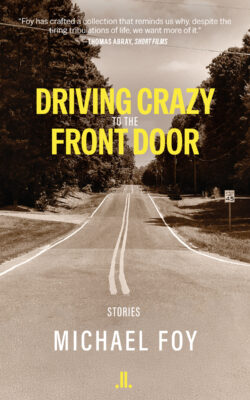
Michael Foy
$25.95
paperback
234pp
9781773902043
In “Starting People,” about a couple who adopt a neglected dog after losing their second baby, the temptation to swerve into a morality tale is avoided through humour and a subtle shift of focus. They find a farmhouse in appalling conditions where the smell of feces and urine “ploughs their noses,” the gyprock is pocked with holes throughout, the mouldings are chewed, the walls are scratched. “We’ve had problems with squatters on our property,” the breeder explains. “So I moved in… I lost my job in November and then this pain in my lower back started up. I’m on disability now. Do you guys want something? A cup of coffee?” They decline the coffee and go see the dogs in the garage, a cacophony of barking behind a metal door, too many together, the one they’ve been promised growing a golf-ball-sized cyst on its forehead. Sure, they call the SPCA after they leave, but they take the puppy anyway, and the woman who has suffered two miscarriages lifts it “like a warm pie onto her lap.”
Foy teaches psychology at John Abbott College, so it’s no surprise to find adolescents featuring prominently in his work, and teachers serving as protagonists. In “Ways to Hold a Gun,” arguably the most layered story in the collection, a Vancouver teacher is lured to Las Vegas, where the American obsession with guns enters his life. “Mark hears gun talk everywhere. It puts him on edge, changes the way he drives. Never honk, gesture, or make eye contact with other drivers.” But he is drawn to the strip, the sunshine, the no-limit hold ’em poker. Only when he must discipline the daughter of a backroom casino worker, a man known to bring his gun to parent-teacher meetings, does he realize that the stakes here are different. What happens next unfolds slowly, and the ending will surprise.
For Quebec readers, this collection offers a rare glimpse out west. Like the Fraser River, it winds through unfamiliar yet common territory.mRb


0 Comments