



Nigel Thomas’ A Different Hurricane is a beautiful, brutal book about love in all its complexity. Looming over it is a question: How do you live in a society that condemns your existence, that hates you for your sexuality?
A poet, novelist, and retired professor of American literature, Thomas is no stranger to themes of homophobia and queer oppression. “I carried this story for a very, very long time,” Thomas tells me on a video call. “Even before the AIDS epidemic, I carried this story with me.”
Thomas’ debut book, Spirits in the Dark, published in 1993, was the first Caribbean novel to feature an identifiably queer main character. It brought him into the public eye in his native St. Vincent and the Grenadines, where he became known as a queer-rights activist – and where homosexuality remains a criminal offence today.
“I’m from an island where most gay men married as a way of preventing themselves from being persecuted,” he explains. “If you looked gay, you would be teased and abused. And so to avoid that, people simply pretended they were not.”
Pretend is precisely what Gordon, the sixty-eight-year-old protagonist of A Different Hurricane, chooses to do. We meet him in 2017 as a semi-retired economist living in Kingstown, working for the St. Vincentian government. He has spent a lifetime masking his homosexuality behind a heteronormative veneer: a well-to-do family man with a wife and daughter. Now, though, cracks in his edifice are starting to emerge. His body shows the signs of living with AIDS – a disease he contracted from one of his many affairs with men, and which he passed onto his wife, Maureen, who then died.
Living with AIDS is just one of Gordon’s worries. More pressing is the fact that Maureen kept a journal documenting his infidelity. Now, their daughter Frida – en route from Toronto to visit Gordon – expresses a particular interest in her mother’s journal and what secrets it contains. A storm is brewing.
A Different Hurricane is more than a story of one man’s lies and their consequences. It is a generational saga, excavating the layers of trauma that build up in a family, and how that trauma so often contributes to, and culminates in, tragedy. “This is a novel that holds a mirror up to nature,” Thomas says. Throughout the book, Thomas delves into the history of St. Vincent, interweaving real and fictionalized events. Excerpts from Maureen’s journal recount what she hears on the radio and reads in the newspapers, providing snapshots of history that deepen the narrative’s scope.
One of the most surprising revelations from my conversation with Thomas is that he didn’t write these excerpts independently. Instead, he constructed an entire eighty-seven-page journal written from Maureen’s perspective over four years, which he then inserted piece by piece into the book. “I spent two weeks in the archives,” he says, “reading newspapers, seeing what’s going on,” to build Maureen’s perspective. There’s a documentary style to it all. “Some of the names mentioned in the book are historical figures. In some cases, I barely altered their names, but I keep the facts so everyone [in St. Vincent] knows to whom I’m referring… I read one particular incident where there was a man who dunked a boy, a thief, in boiling water. I chose to include that particular incident in my story because I wanted to point out the kind of cruelty that can exist in society.”
A Different Hurricane Dundurn Press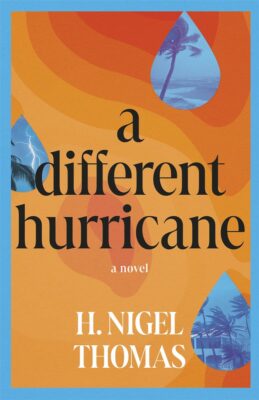
H. Nigel Thomas
$25.99
paper
256pp
9781459754065
The violent history in A Different Hurricane is real, palpable, and at times insurmountable. Yet, a ray of hope shines through. Despite the violence Gordon and Maureen experience growing up (or perhaps because of it), they are never cruel to each other or their daughter. They eschew violence. Maureen in particular stands out as one of the novel’s most interesting characters for her compassion and capacity to forgive. Notably, her view is the only one presented in the first person, through journal excerpts; all others, even Gordon’s, are told in the third.
When I ask Thomas if he has hope for the future of queer Vincentians, his answer is emphatic. “Yes, yes, yes,” he says. “My queer contacts in St. Vincent are no longer around, unfortunately. One of them was a victim of AIDS. But I am in contact with queer Vincentians who live abroad, including one of two guys who challenged the criminalization of homosexuality law in St. Vincent. I go back to St. Vincent often, at least once a year, and I tell gay people there to claim their space: Talk about your sexual orientation. Make it clear you belong and are not going anywhere.”
Thomas tells me about a recent interview he had with a Vincentian literary group, Page Turners Plus, which criticized A Different Hurricane’s depiction of gay men. “They accused me of reifying the stereotype that gay men are vectors of HIV,” he says. According to the group, such depictions set back Vincentian gay rights and efforts to decriminalize homosexuality. He expresses shock at the accusation. “What is the argument?” he asks. “You can sense a certain discomfort on the part of the reviewers.” Thomas’ concern is well-founded. More than forty years have passed since the AIDS epidemic began. Today, we are witnessing renewed efforts to stymie and erode 2SLGBTQI+ rights, in North America and beyond. Lawmakers, among others, call into question the representation of queer and trans people in books, film, educational settings, and elsewhere. If these stories can’t be told now, when can they be?
One of the rare moments of physical and emotional tenderness between Gordon and Maureen comes roughly four-fifths of the way through A Different Hurricane. Maureen has recently learned of her AIDS diagnosis. Gordon wonders why she hasn’t left him. Instead of answering him, she – in schoolteacher fashion – hands him homework: Carson McCullers’ short story “A Domestic Dilemma,” which he promises to read later. She’s doubtful; he’s never been fond of literature. But at breakfast the next morning, she can tell he’s read it simply by the “triumphant look” on his face. “I love it when the little child in you pushes aside the adult,” she says. He thanks her for sharing the story and compares himself to Emily, the mother in the story, whose alcoholism tears apart her family. He cries. She reaches for his hand. Tears fill her eyes. Here it is: love, in all its facets – all its complexity. mRb


The book is rivetting and revealing.
The review surfaces and highlites that there is much more to be learned from its source.