


When Mélikah Abdelmoumen walked into a police station in her Lyon suburb in 2017, she writes in Baldwin, Styron, and Me, she was hoping for some semblance of compassion.
The author filed a report with a police officer after enduring a purse-snatching and assault only steps from her front door. The swift attack was tinged with a lasting pain: the perpetrator spat a racist slur before fleeing the scene. The officer was sorry that a “foreigner” would experience this kind of violence while in France, especially one from Quebec. She thought of the Québécois as “frank and open, sweet and innocent; to her, Quebec was a land of unicorns.”
Abdelmoumen was used to the condescension, constantly defined as foreign in her adopted home, even after twelve years. She writes that she wasn’t prepared, though, for what the officer said next: “France was being invaded by Islamists who killed people … She was really talking about North Africans. Arabs. Muslim-looking people.” An incredulous moment of being victimized twice over: “I had come to her as a Québécoise immigrant who had been the victim of a mugging and subjected to anti-Arab insults and physical injuries. Her response was that the Arabs were to blame, as was my own naïveté as a Québécoise.”
Abdelmoumen somehow finds empathy for the officer – empathy that was never reciprocated. Her attention to language as a writer, combined with her insights as an immigrant, have made her into a precise observer of how othering works. “She couldn’t take it, and she didn’t know how to keep going […] She was probably just as fed up as I was. But her comments were also racist.” Abdelmoumen’s understanding never compromises her steadfast demand for something more just; rather, her compassion reinforces it.
To make social transformation possible, to manifest a world free from racial and colonial terror, how do we learn the monumental task of hearing each other? Baldwin, Styron, and Me, translated by Catherine Khorduc from the original French (Mémoire d’encrier, 2022), emerged from fierce debates in Quebec and in France on cultural appropriation, ownership, and subjectivity. Her answer to those tensions looks backward and southward, to a friendship that grew over sixty years ago between the two literary giants invoked by the book’s title: James Baldwin, a descendent of slaves born in Harlem, and William Styron, the grandson of a white Virginian slaveholder.
When Abdelmoumen discovered Baldwin, she was invigorated by his writing on everyday people contending with legacies of race and subjugation in the United States and in France. She tells me in our interview over Zoom that in 2015, during the far-right political torrent sweeping the country, “I remember reading Baldwin and feeling that somebody understands, even though it was a few decades ago.” For instance, in the 1960 story “This Morning, This Evening, So Soon,” the Black narrator living in Paris, protected from racism’s shadow by his Americanness, is the only one to defend a Tunisian man accused of stealing by the white attendees at a party. “The effect these words had on me, an Abdelmoumen in France in the 2010s,” she writes. “I had suddenly found a brother, and his name was James Baldwin.”
Styron, Baldwin, and Me Biblioasis 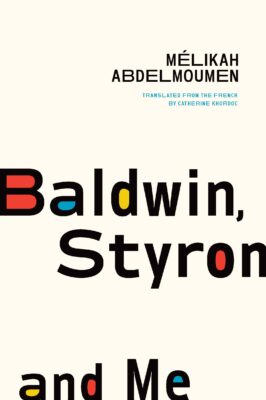
Mélikah Abdelmoumen
Translated by Catherine Khorduc
$22.95
paper
160pp
9781771966269
The proximity could have been explosive. But during Baldwin’s stay, they became just Jimmy and Bill; writing together, and sharing drinks during late-night conversations on the racism of their day and what they dreamed America might be. From their discussions, Baldwin began making notes for The Fire Next Time (1963), a book that cemented him in the American canon. Jimmy encouraged Bill to write his career-defining novel; to pursue the ghosts of a crushed slave rebellion that had risen in 1831, only two hours from his hometown. The Confessions of Nat Turner won Styron the 1968 Pulitzer Prize and national controversy, with some readers contesting a white writer inhabiting the voice of the executed insurrectionist.
“The connections made, the heated exchanges, confessions, commitments, promises… I’ve pictured all this so many times,” Abdelmoumen writes. Baldwin, Styron, and Me has lived many lives. First, it was a 2019 article in acclaimed Quebec magazine Spirale. Then it was performed in the 2021 Festival international de la littérature (FIL) as a lecture spectacle: “Theatre that pays homage to literature,” Abdelmoumen explains in our interview. “There was music, there was movement and dialogue … It was already hybrid from the start.” She had long imagined dramatizing the men’s friendship, but the book it became owes its existence to a friend of her own. Film director Marie-Hélène Panisset was a reader of early versions of the text. Panisset insisted, “‘Everyone should know this story, now more than ever,’” Abdelmoumen writes. “This story of an improbable unwavering friendship – a bit like our own?”
Abdelmoumen’s entanglement with Baldwin and Styron throughout the years distinguishes her retelling. The book unfurls as an intertextual love story, combining memoir, correspondence, dramatic monologues, and quotations from the authors’ work. Its climax, for example, is shaped entirely from the transcript of a broadcasted debate between Styron and actor/activist Ossie Davis, discussing the ethics of a potential film adaptation of The Confessions of Nat Turner. Baldwin, who moderates, opens the occasion with, “I’m sitting between two friends of mine,” setting the precedent that hard conversations can be acts of love. Likewise, the formal innovation of Baldwin, Styron, and Me captures the risk inherent to both making art and forming relationships. By opening ourselves to friction, we trust in the potential of being transformed. “We never talk enough about how these texts, which are supposedly solitary endeavours, can emerge from a collective surge of energy and effort. Through a chain of shared ideas,” writes Abdelmoumen.
In the 1980 essay “Dark Days,” Baldwin writes about one of his seminars: “They began talking to one another, and they were not talking about race. They were talking of the desire to know one another, their need to know one another.” Baldwin, Styron, and Me, Abdelmoumen’s first book to be translated into English, is just the author’s latest experiment in this regard. She relates in our interview how she went as far as to expand certain sections in the translation. “Biblioasis publisher Dan Wells told me, ‘Here, we don’t just translate, we adapt. Do you mind?’ Well, this is the whole process of this book, right? Adaptation after adaptation, and adaptation is recreation, which I think makes the relationship to the work really vibrant and alive.”
She’s particularly excited about the book appearing on shelves in Baldwin and Styron’s native country. In a Quebec literary landscape that often yields to a narrative of linguistic fragmentation promoted by the political class, Abdelmoumen’s curiosity is refreshing. “Now I’m talking for the first time in my life to an anglophone audience. What is it I think they need to know to get my work?” She is a good reader of Baldwin; on the journey, as he wrote of his seminar students, of “trying to become whole.” mRb
0 Comments