


In February 1807, Charity Bryant arrives in Weybridge, Vermont, to visit her church friend Polly, whose unmarried sister, Sylvia Drake, lives with her, helping to care for her many children. Charity is fleeing a devastating breakup and, wherever she goes, gossip follows “like dirt on a hem.” Rumours abound that she harbours a strange interest in women.
Charity & Sylvia Drawn & Quarterly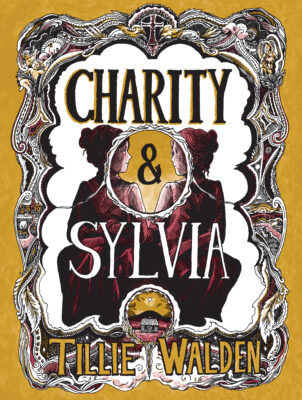
Tillie Walden
$38
hardcover
264pp
9781770468382
Drawing on diaries, letters, and archival materials, Tillie Walden evokes the vivid world of Charity and Sylvia in late eighteenth- and nineteenth-century New England, where toil, death, and religion loom large. The award-winning graphic novelist renders this world in intricate black-and-white drawings, set within twelve-panel pages, with a wash of sepia to suggest the faded hues of the past. She further enhances the narrative with interwoven maps, anecdotes, and historical facts, adding depth to daily life in the period. Walden’s work succeeds as a richly grounded, deeply affecting portrait of love, labour, and religious anxiety.
To call the condition of women in this period a plight is almost an understatement. They toil without respite, tending large families and keeping hearth and home. Walden often depicts mothers hard-pressed to maintain a semblance of order. Charity and Sylvia, too, labour ceaselessly at their tailoring business, and it eventually flourishes, allowing them to establish a home of their own. In contrast, their lives are markedly less burdened than those of their sisters and sisters-in-law, whose days are consumed by the demands of children.
Beyond this unending labour, the lives of Charity and Sylvia are shaped by birth and loss. Both Sylvia and Charity are the eighth-born children of their respective families. Sylvia’s family is poorer: five of her siblings are sent to work as children and adolescents in the homes of relatives or the more affluent, while most of Charity’s siblings, along with her mother, die young.
Though surrounded by loss, Sylvia and Charity live long lives yet remain troubled by what awaits them after death. Sylvia, the more devout of the two, fears that they live in sin and is haunted by visions of hellfire – scenes Walden renders through darkness, flames, fallen angels, and the devil himself. Charity reassures Sylvia that they are good Christian souls, yet years later confesses that she still feels persistent shame and that she, too, fears their fate. This tension between fear and fate makes the ending all the more compelling.
The artistry of Walden’s panels is consistently strong throughout, and their richness in period detail draws the reader into an immersive and convincingly rendered world. Although it is impossible to determine a definitive standout, “They Will Very Nearly Die” and “Hurry, Hurry, Hurry” are the most memorable panels for me. Walden admits to having filled in some gaps in the story, yet the work nevertheless feels meticulously researched. Even on a third reading, I continued to glean new details.
My only significant criticism relates to the number of characters, especially those with similar names or younger characters named after the deceased, which can be confusing at times. This remains a minor concern, as the similar names reflect the complexity of the two large families.
Overall, Charity & Sylvia is a thoroughly engaging work that rewards both slow reading and rereading, its layered narrative bringing these two figures vividly to life.mRb

0 Comments