


In Lavender Spike, Montreal author Rachel Tremblay describes the post-apocalyptic city of Etching, where art has been turned into a drug, a source of endless wealth for those who produce it and an addictive scourge for its users. After a deadly revolution known as the Great Burn, Etching stands divided. At its centre lies Mahl City, a sheltered metropolis where artists known as “Triggers” are worshipped by their happily addicted fans; outside its fortifications are the Dumps, where those who refuse to give in to the addiction live in fear of the city’s art dealers. This is where we meet our protagonist. Izzy is a “Purist,” an artist trained before the Great Burn whose paintings, though not addictive, are rather bland. When her studio is ransacked, Izzy finds herself in the midst of an uprising – she is sent into Mahl City to impersonate a Trigger and help the Half-Light Rebels bring equality to Etching. But given the chance to finally “make someone feel… something,” will she be able to resist the appeal of life as a Trigger artist?
Lavender Spike ECW Press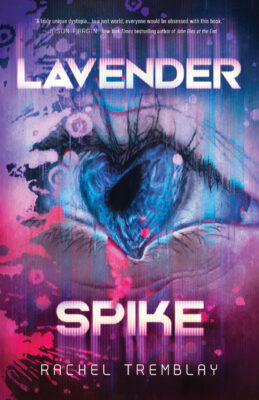
Rachel Tremblay
$24.95
paperback
384pp
9781770418417
Unfortunately, just as the “lavender spike oil” evoked in the title is used as a natural paint solvent, so too has the plot of Lavender Spike been diluted. The reader never comes to understand why the Great Burn took place, or why Trigger and Purist artists must compete. Mahl City does not depend on the Dumps for any resources; people in the outskirts are seemingly repressed for no financial or even artistic gain. While a rebellion against meaningless poverty is certainly understandable, the connection between art and the Half-Light struggle is essentially nonexistent. This political upheaval, presented as central to the plot, is also crammed into the last quarter of the book, where the pace suddenly picks up and Mahl City falls by the power of one contrivance after another.
One also finds it difficult to understand the needless sexualization of women in Tremblay’s writing, especially since the story is largely told from the perspective of an (allegedly) heterosexual woman. Yet, Izzy pays more attention to “the undersides of [Joannie’s] bare breasts” or a “woman in black cut-off jean shorts, her bottom cheeks peeking out,” than to her male love interest. Given the presence of other queer characters, by the time we reach the single, cringe-worthy sex scene, the reader cannot really be blamed for their disbelief.
These kinds of flaws are endemic to many contemporary YA and romantasy books, which abandon the philosophical foundations of the genre fiction they draw upon. Instead, they posit literature as a form of escapism rather than an arena in which to confront social problems. Tremblay, for instance, does not push her fiction far enough to seriously consider the commodification of art or the challenges of romantic relationships between members of different social classes. Nevertheless, there is nothing wrong with a little entertainment. Lavender Spike indulges in a dystopian fantasy of what the world might be like if artists, rather than lawyers, bankers, or programmers, were revered in society. If you enjoyed TV shows like Arcane (2021) and Cyberpunk: Edgerunners (2022) or even Melissa Marr’s Wicked Lovely (2007), then Lavender Spike may be your brand of reprieve.mRb

0 Comments