

Nyla Matuk’s Leila & Khaled is at once a romance novel, a travel narrative, and an intimate portrayal of a diasporic woman who wants to better understand her family’s history and, by extension, a nation’s. The novel’s protagonist and narrator, Leila, is a middle-aged Palestinian-Canadian film scholar who travels to her ancestral homeland under the pretence of an academic delegation trip. Leila explains that she “had come here to see,” but omits the verb’s direct object, prompting readers to fill in the gap with implied objects. Nevertheless, she repeatedly questions the ethics of merely witnessing the ongoing violence, disillusionment, resistance, and rage that surrounds her. Navigating waves of grief, anger, and guilt, Leila is caught off guard by an unexpected emotion: desire. Instantly smitten with Khaled, one of the delegation’s tour guides, Leila finds her trip transformed by an enthralling romance.
Leila & Khaled Houes of Anansi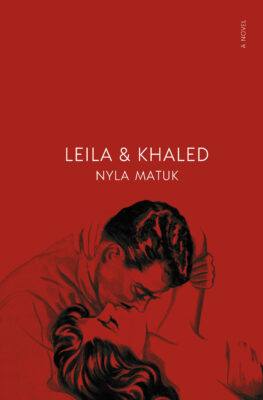
Nyla Matuk
$26.99
paperback
224pp
9781487013974
The novel also asks what role art might play in the dark tourism industry. A scene set in the Banksy-designed Walled Off Hotel in Bethlehem highlights the quiet intensity of Matuk’s writing and her skill at grappling with this complexity. Built in 2017, the controversial boutique hotel, which faces the West Bank barrier erected by the Israeli government to enforce its apartheid system, is a popular tourist destination. Here, the novel’s characters debate whether being customers of the hotel makes them complicit in Palestinian oppression. Ultimately, the delegation can’t come to a consensus on whether the hotel is a shameless commodification of violence, “a fetish shrine,” or a symbol of resistance. Counteracting the group’s instinct to overintellectualize, Khaled explains that “it helps the cause of liberation to witness art close to state projects – jails, walls, concrete barriers” because it invites people to consider “what could be there instead.” In many ways, the novel itself serves a similar purpose: to highlight how the act of witnessing can be a powerful form of confrontation.
Set at the outset of the COVID-19 pandemic, Matuk’s depiction of Palestine is unlike the one we have come to picture in the wake of the war in Gaza. In the novel’s present, the country is filled with tourists, from “American Evangelicals” to “Malaysian Muslims” visiting the sacred sites depicted in their holy books. Through this setting, Matuk depicts quotidian life in Palestine shaped by an apartheid system, while also offering readers an unflinching portrayal of the violence, both subtle and overt, perpetrated by the Israeli military tasked with enforcing it. The delegation’s tour is mired by checkpoints, suspicion, and persecution, yet Leila is painfully aware of how her status as a Canadian tourist affords her relative immunity from the brunt of the discrimination faced by the Palestinian locals around her. All the while, her romantic and intellectual connection to Khaled serves as a respite from it all.
The novel is primarily dialogue-driven, as Matuk boldly takes on the task of informing the reader about the prolonged conflicts that have shaped the region. However, the author’s understated prose shines most when it depicts Leila reflecting on diasporic identity, exile, dispossession, and how love can be a powerful form of resistance. Few novels succeed, as Leila & Khaled does, in pivoting between meditative scenes and nail-biting ones with such swift precision.mRb
0 Comments