


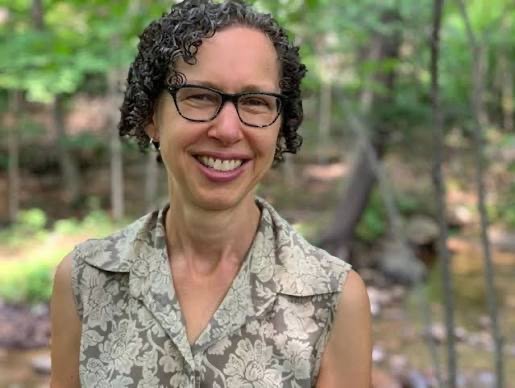
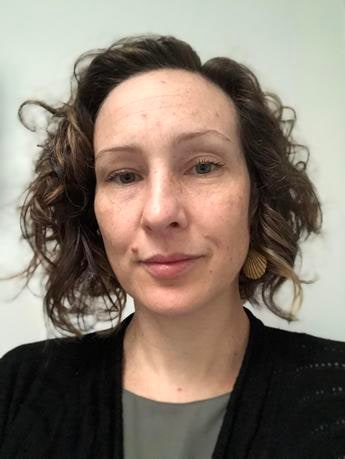
On the crest of a late summer heatwave, I interview poet Stephanie Bolster at her Concordia University office. Bolster and I first met a decade ago, when she taught a poetry class that shaped the trajectory of my future – a claim that would feel laughably melodramatic had I not heard the same from countless others. Students often note Bolster’s attentiveness, dedication, and – perhaps most of all – ability to recognize startling language in voices frequently overlooked.
Long Exposure Palimpsest Press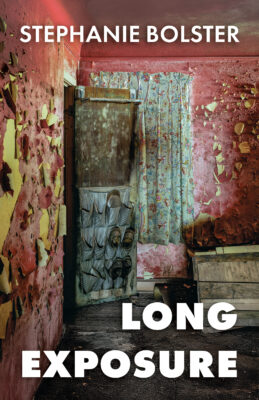
Stephanie Bolster
$21.95
paperback
152pp
9781997508014
Temporally and geographically expansive, Long Exposure’s apparent digressions sediment into uncanny layers. Rules from the Tashme Internment camp for Japanese Canadians abut advertisements for the same region today: “Now Sunshine Valley. / One of BC’s best kept secrets.” Meanwhile, under COVID-19 lockdown, the speaker witnesses another upsurge in anti-Asian racism. As she researches natural and human-made disasters – and confronts the instability of these distinctions – pages jolt with the speaker’s attention between Chernobyl, New Orleans, Japan, Hastings Park, rows of empty Zoom rooms. Stanzas written during lockdown interpose earlier compositions, the newer sections jutting in from the right margin. While perhaps the most accurate poetic rendering of a digitally splintered consciousness I have yet encountered, Long Exposure’s ambition far exceeds a poetics of the doomscroll. Uniting this disparate mosaic is a profound concern with the ethics of witness: an ongoing reckoning with mortality, injustice, legacies of harm, and our responsibilities to one another.
Bolster traces the genesis of the book to a 2009 Musée d’Art Contemporain retrospective for Canadian-American photographer Robert Polidori, best known for his shots of dilapidated interiors in the Chernobyl Zone of Exclusion and post-Katrina New Orleans. “I was unsettled by looking at Polidori’s photographs,” she tells me. “He had essentially trespassed to enter these spaces, [from which] the occupants had been evacuated or fled.” At the same time, the photographs conveyed “the nature and scope of the suffering” more effectively than the television news. “I was witnessing his witnessing and was drawn to this, but also uncomfortable.”
On the water-soft walls in the photographs, funguses bloom in rich, saturated pigments. Such tensions between suffering and aestheticization constitute a central theme in Long Exposure: where is the line between witness and voyeur?
He chose where to stand.
Where to look. Reveals
where he set the edges. The exposure
went in his lungs to live forever.
I ask Bolster whether writing this book was also a process of choosing where to stand, an act of setting and revealing edges. “I think it’s really all edges, in a way,” she says. “I’m not sure there is a centre.”
Rather than discrete poems, narrative progression, or eventual answers, Long Exposure coheres – to the extent cohesion is intended – through reoccurring images. Empty rooms, parents and children, and, especially, water. “Water embodies a lot of the ambivalences and ambiguities within the work,” she explains. “The areas that used to be freshwater are now saltwater around New Orleans. With climate change and sea level rise, saltwater is coming in where there used to be marshes. Water is the constant thing. It’s the thing that comes back. But it’s also not the same water that it was 100 years ago.”
Having grown up in Vancouver, Bolster adds, “I think I’ve been writing about floods my whole life.”
While addressing longstanding themes in her oeuvre, Long Exposure is the most formally bold of Bolster’s books. “I knew going into it that I didn’t know how to make the thing that I wanted to make.” Composing in “fragments and layers” was both a procedural choice and a necessity; Bolster began the project when her second daughter was born, writing in “little corners of time” while the baby napped. “Each time I would sit down to write, I was kind of starting anew.” At one point, she amassed 1,200 pages.
Far more than Bolster’s previous work, Long Exposure resists “poetic” language. Her keen ear remains evident – the 2011 Tōhoku tsunami is “a thing alive so wrong one couldn’t call it water” – but there is little use of metaphor. Syntax is clipped, stark, abrupt. “I’d been praised in the past for ‘beautiful’ writing,” Bolster says, “but I came to be suspicious of [that impulse] because it felt like my intentions were in the wrong place.” After twenty-five years teaching creative writing, she tells me she harbours a level of distrust for “the well-crafted poem,” noting how superficial polish can impede deeper risk. While Bolster notes that there can be value in technical polish, she says, “The dismantling of [aesthetic perfection] is really instructive.”
Long Exposure is also striking for its ever-present yet decentred speaker. Pages often pass without first-person pronouns, yet “I” remains implicit: scrolling, reading, watching. After a conference on positionality in writing, the speaker says,
[…]We wanted
not to harm. We wanted
(I wanted) to disappear
I ask Bolster why it was important that this “I,” however ambivalent, remain. “I’ve heard it said the only safe terrain is to write about oneself because you’re not encroaching on anyone else’s material experience of trauma. But at the same time, I don’t feel like I know where I end and someone else begins […] There’s no pure self that is not touched by other people.” It felt important, she adds, to “take the risk of engaging,” while acknowledging her own subjectivity. “Including those stories, but then including my own response to them, including my unease about my own response to them, my unease about including them, felt like a necessary part of the project. The self wants to disappear but can’t not be there.”
Bolster’s approach, therefore, was for this self to “admit to being there,” rather than writing as a “ventriloquist” for others’ voices or presuming to share the same risks. Long Exposure persistently grapples with the simultaneous impossibility and inevitability of entering other lives. Visiting a friend during the pandemic, the speaker remarks,
We are sure we are safe.
We don’t say we are almost
in each others’ bodies now.
These poems suggest our fates depend on one another, yet also recognize that attempts at closeness may instead do harm. Bolster therefore makes extensive efforts to seek permission from those whose stories she includes, most of which were originally encountered in news broadcasts and documentaries, particularly Spike Lee’s When the Levees Broke. The book’s lengthy endnotes describe “cut[ting] many passages whose speakers/authors [she] could not locate or who could not give permission.” They continue, “If your experience is here and I haven’t found you yet, please contact me.”
Like Anne Carson’s Sappho translations, Long Exposure carries a sense of wreckage, of trace: a remnant broken from something much larger, water-gnawed and impossible to remake as it was. Elegiac, moving, and unsettling, Long Exposure is at once a portrait of an era and a reminder of how much inevitably lies beyond any artwork’s frame.
A few days after our meeting, Bolster emails to add: “I thought the book was basically finished in 2020 but kept being struck by connections between elements of its content and the experience of living through the pandemic. […] The implication, I hope, is that I could keep on doing this — the flood of experience is ongoing.”mRb
0 Comments