

To say that poetry has undergone significant changes over the past century would be an understatement. Beginning with the modernist movement, the second industrial revolution of the twentieth century changed the way we work, travel, and communicate, while world wars, shifting borders, and mass migrations changed our philosophies, politics, and the voices that carry them. Fast forward a hundred years to our current, rapidly changing, twenty-first-century landscape and we live in a “meta-modern” age, in which ongoing, geopolitical disarray floods our news channels on numerous digital devices; the dystopic threat of AI as well as (social) media driven self-consciousness loom large; and amidst all this chaos, art constantly evolves alongside the humanity that creates it.
On Occasion Coach House Books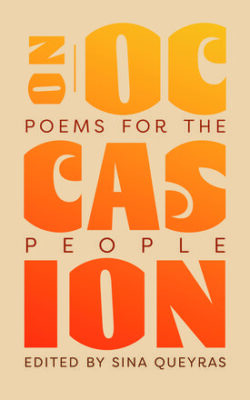
Poems for the People
Edited by Sina Queyras
$24.95
paperback
200pp
9781552455227
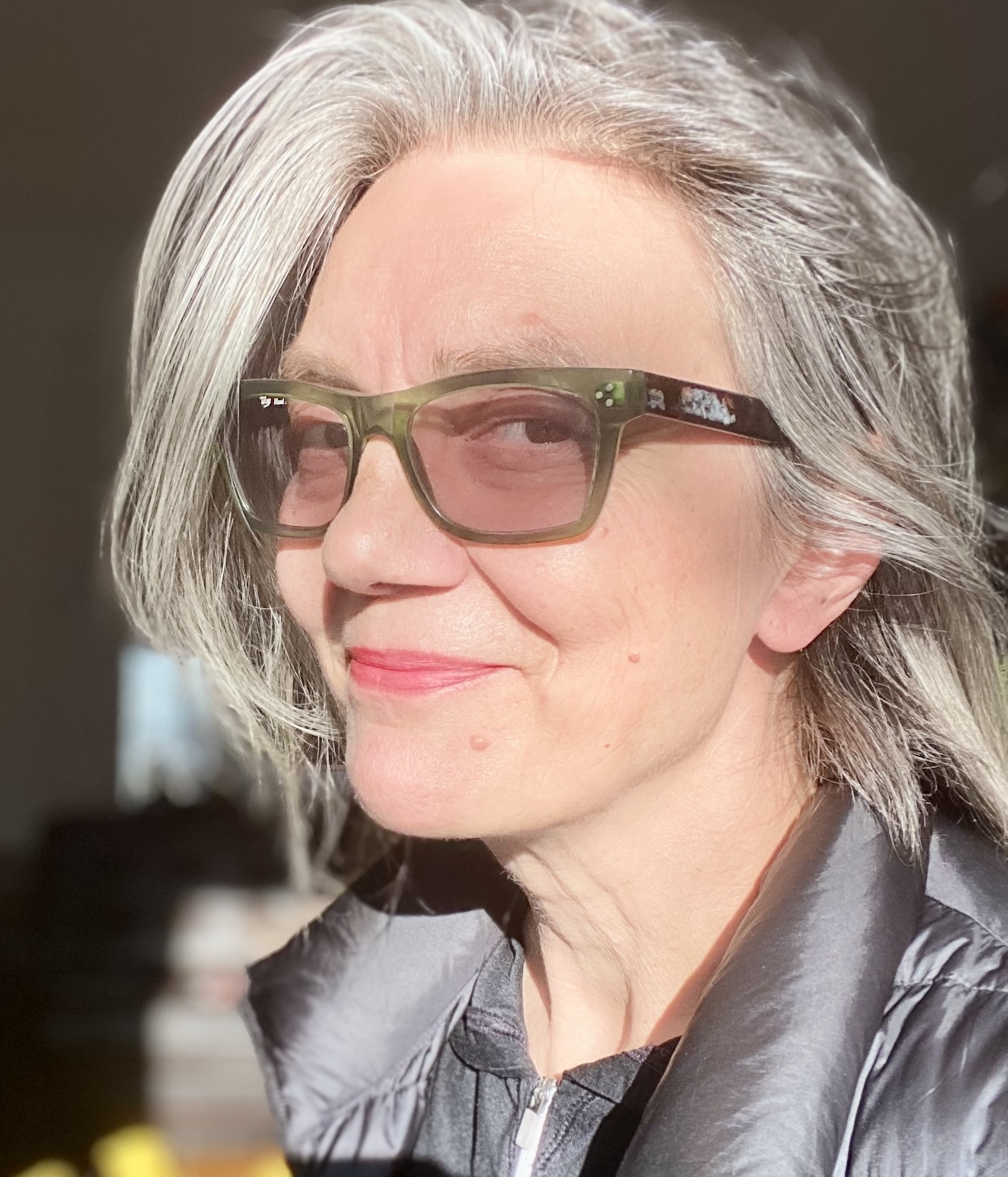
Originally from Manitoba, Sina Queyras is now based in Montreal and the author of eleven books. They won the Pat Lowther Award, the Lambda Literary Award, and the A.M. Klein Prize for Poetry, and they also founded the online literary journal Lemon Hound, as well as Concordia University’s Writers Read Reading Series. Their latest editorial anthology On Occasion’s subtitle: Poems for the People is a nod to the poet, playwright, and essayist June Jordan, who founded Poetry for the People (or P4P) in 1991, an arts and activism program at UC Berkeley “designed to democratize poetry and foster community through creative writing.” In 1995, Jordan’s Poetry for the People: A Revolutionary Blueprint was published, covering the methodology of the P4P program and guidelines on how to establish grassroots poetry workshops. Queyras attests to this endeavour on the need for creative writing resources that exist beyond academic settings, for the purpose of greater accessibility and to cast a wider net covering diverse perspectives on both the subject and the creation of poetry (and literature in general).
During our conversation, Queyras explains to me how they felt poetry well before they penned their first poem, and were influenced by their mother, who exchanged poems in the form of letters to her sister (Queyras’ aunt). They found inspiration in early readings of Margaret Atwood, and W.H. Auden’s “The More Loving One” (which was, interestingly, featured in the New York Times’ recent Poetry Challenge in April of 2026). Also among Queyras’ earliest influences was the emergence of CanLit, a call to follow the work of living poets (rather than merely those who had passed away), as well as the work of writers making modern breaks with tradition, such as Gertrude Stein.
Long in the making, the seeds of Queyras’ immense editorial project were gradually planted and stemmed from their own personal love of occasional poems, defined in the anthology by Queyras as “In its simplest sense, [a poem that] people reach for ‘on occasions’.” All things considered, regarding poetic influences, Queyras elaborates on the definition of ‘occasional poem’ when they write: “To my mind, the occasion for many poems begins in emotion, or image, rather than external occasions, though often emotion, image, and occasion overlap.”
In the spring of 2025, Queyras reached out to Alana Wilcox, the editorial director of Coach House Books, and the fall deadline was set. They ended up including more material than originally planned, with twenty-five extra pages added to the final version. Still, as quoted from an article on Queyras’ website, “On the Occasion of the (unboxing) of On Occasion”: “I plan on doing a round two, so hold on!” In the introduction of On Occasion, after Lewis Hyde’s reflection on the relationship between creativity and the gift, Queyras writes: “After an expansive journey through time and cultures, tracing the outcome of gifts that turn into commodities versus those that remain gifts, we can conclude that a poem is a gift. That it is alive and contains an element of the universe. That it keeps on giving, transforming as it moves through time.”
While both a joy and a gift, this endeavour was also truly a labour of love, between scrambling to acquire copyright permissions, curating the anthology, and finding the right categories for occasions (with many poems finding equal belonging across multiple sections of the book). There are ten sections altogether, including typical occasions such as marriage and birthdays, as well as more novel concepts of occasions like embodiment and ongoingness – plus many more. There is also a companion website to the book, offering a generous selection of reading recommendations for more occasional poems as well as interviews with the contributing poets.
The book itself opens with an anchor poem from Years, Months, and Days by Luke Hathaway, immediately establishing the anthology’s theme of birth, life, death, and seasonal cycles. Captivating visual poetry, another hallmark of the anthology, is also interspersed throughout, alongside emerging Canadian talent, as well as established writers such as Ursula K. Le Guin, Sue Sinclair, Billy-Ray Belcourt, John Barton, and June Jordan. True to anthological form, many of the poems are juxtapositioned in conversation with each other, and ebb and flow between contrasting tones of grief and humour. Queyras explains that, even despite having exceeded the original amount of planned material, they would have liked to have included written accounts of spoken word poems, as well as more poems from queer authors.
Regardless of one’s identity, or should we say because of it, every writer deserves to be the recognized author(ity) of their lived experiences. Queyras invites us to see the friendlier and more human side of poems; also, that they are not (always) the intimidating, cryptic riddles bent on making you look and feel dumb – a feeling that many writers, both inside and outside of the academic discipline of literature, have often experienced. At least, it doesn’t have to be this way. Toward the end of our conversation, Queyras quotes Fran Lebowitz – “The closest thing to a human being is a book” – and then adds, “Poems are the closest we can get to a human being.”mRb
0 Comments