



“I do believe writing is a self-fulfilling prophecy,” Catherine Leroux tells me, deep into our discussion of her latest novel, Republic of Glass, translated from French by Katia Grubisic. I’ve brought up the phrase because it appears as a lone statement, on a page by itself, in the heart of the book. It could be read as a warning or as an incantation for liberation. Leroux explains that she believes it to be true on multiple levels. On the micro level, she has personally experienced the eerie phenomenon of her own life mimicking the events she writes in her novels. “I don’t want to say that writing is magical,” she muses, “that we are conjuring things. But I’m open to the idea that maybe there are… premonitions.”
Republic of Glass Scribner Canada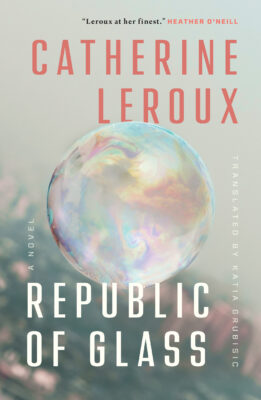
Catherine Leroux
Translated by Katia Grubisic
$32.99
hardcover
272pp
9781668093313
Authorial responsibility, and the possibilities of conjuration via the written word, are central preoccupations in Republic of Glass. Leroux’s fourth novel is a compelling tale of growing urban precarity, government hypocrisy, and slippery personal truths, and was born from Leroux’s own experiences of housing uncertainty in the early Covid-19 pandemic. “But what transformed that personal moment into something bigger that I could turn into a book was that it was generalized and exacerbated by the way the housing crisis was exploding,” she explains. Suddenly, Montreal, where she has spent her whole life, was no longer a city of “cheap apartments for everyone forever.” Her anger about this worsening phenomenon, and the pre-existing injustices it exacerbates, fuelled her writing process.
The story takes place in the near future, in which the Quebec government has begun locking up the ever-ballooning population of unhoused people in a new type of institution, with locations all over the province: the cheerfully named HAPPI (the Housing Assistance Program for Public Improvement). Of course, there is nothing happy about these places, which function similarly to the debtors’ prisons and workhouses of nineteenth-century Europe. Leroux chose the acronym to point to our province’s tendency to “hijack language” for their own purposes: “This is one of the things that power does, especially governments that are more on the right. They use language and they turn it into whatever they want.”
Sidonie, the novel’s protagonist, was once a successful journalist on the housing beat, but is now locked up in a HAPPI unit herself, having lost her comfortable apartment in a perfect storm of bad breakup and professional disaster. In its constrained and repressive atmosphere, she tries to maintain her sense of self by writing down her thoughts and experiences in a notebook. These entries form the main storyline of the novel. Or so it seems.
Republic of Glass is deeply concerned with the growing crackdowns on encampments in the 2020s, and the disastrous consequences of skyrocketing rents; at the same time, it is not a straightforward story of political repression and injustice, good vs. bad, oppressed vs. oppressors. Though the novel is clear in its stance against state repression and capitalist greed, Leroux’s ability to sidestep didacticism in favour of multilayered, non-prescriptive storytelling is a real strength. She deftly plays with the permeable boundaries of truth and fiction, which results in a novel that reads like a mise-en-abyme – each time we think we’ve arrived at the ultimate truth of the tale, that truth is recontextualized, and we must zoom in even closer to see its next iteration.
The story Sidonie tells about herself in her notebook is not necessarily the truth; nor are the things she tells the faceless Régine, an institutional representative who presses her for details about her life. Her own personal history, including her work as a journalist, is not as factual as it might at first seem. Even her descriptions of the HAPPI building – the way it’s laid out, how people get in and out, which plants do or do not grow in its courtyard – are both true and invented. Leroux adds further intrigue to the text by completely changing registers near the end of the book, and revealing an entirely new dimension to the novel. She tells me that this late epiphany in her writing process was paradoxically born from her initial desire to keep her personal experiences and the novel’s narrative strictly separate. When she eventually relaxed this fixed boundary, “the fictional story contaminated my personal life,” she says; yet at the same time, this decision “opened up more doors for thinking about housing and home and homelessness.”
As our conversation wraps up, Leroux and I discuss one more important layer of this rich text: the element of translation. She tells me that her first experiences reading her books in English freaked her out: the translated text “ feels both like it’s yours and like it’s something completely different. It feels both familiar and unfamiliar.” She likens it to Freud’s concept of unheimliche: the unease and fear that arise when the familiar becomes strange. It’s a good way to describe the mood of Republic of Glass. However, over the years, she has gotten used to it, and even started to enjoy it; she learned to lean into the collaborative aspect of the experience, something that Grubisic emphasizes in her process. Nowadays, Leroux welcomes the new layers of possibility and truth that translation reveals. After all, she says, the book she writes is never the same as the book that lived inside her head in the first place.
Next up for Leroux is a trilogy, to be published by Alto. She can’t say too much about it yet, but she shares that it’s a love story that evolves over many decades in another world, one that is subjected to constant turbulence. Whether on another world or our own, turbulence and human attempts to navigate it are central in Leroux’s work. “That’s how it feels to be a person living in this time right now,” she says, of the many upheavals in Republic of Glass. “The ground shifts under our feet constantly, the rules of the game are constantly being redefined, the equilibrium is shifting and broken.” Her ongoing project is to recreate these conditions within a literary context.
We can only hope that writers like Leroux will continue to disrupt pessimistic, dystopian, defeatist ideas of a doomed future – and that readers will actively seek these stories out, and let themselves be shaped by them. Writing may be a self-fulfilling prophecy; our choices about what we read have far-reaching implications as well.mRb

0 Comments