


Elizabeth Quinlan, a professor of sociology at the University of Saskatchewan, tells the story of a miners’ strike in Sudbury, Ontario, in 1958. Playing the role of the scrappy underdog in this tale is the Mine, Mill and Smelter Workers’ (MMSW) union, made up of men who did some of the hardest, dirtiest and most dangerous jobs around. The union local chose to strike even though it didn’t have the funds to support its 14,000 members and their families for very long, and despite knowing that their employer, the International Nickel Company (Inco), not only had a near monopoly on the world’s nickel market, but was experiencing an economic slowdown and was sitting on a stockpile it could sell off.
Standing Up to Big Nickel McGill-Queen’s University Press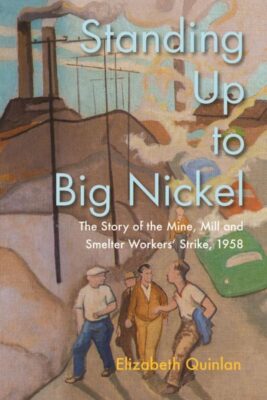
The Story of the Mine, Mill and Smelter Workers Strike, 1958
Elizabeth Quinlan
$34.95 CAD
Paper, eBook
228 pp
9780228024804
To set the strike in its historical context, Quinlan begins by sketching the backdrop and lead-up, including a post-war recession and anti-communist panic. From there, she describes the time of the strike itself, and the union’s scrabbling to keep a whole community of families afloat for three months – while also facing bad press, criticism from the Church, and pushback from the Canadian Labour Congress and the provincial government. Along the way, Quinlan takes time to examine what role women played in this mining town before and during the strike, and how they supported the union. The book closes by looking into the aftermath of this collective action. Despite its success in negotiating a new contract with Inco, the MMSW never fully recovered from the attacks on it, and eventually fell to a takeover by a rival union. Also covered are the impacts of the takeover, in terms of Canadian trade unionism more generally.
Overall, this makes for a compelling story, if a biased one: Quinlan’s portrayals of the MMSW tend toward idealism (she even includes the lyrics to the union folk song “Joe Hill”), and her characterizations of Inco’s motives and tactics are strongly negative, and sometimes unsubstantiated other than by first-hand accounts. The sources Quinlan used include a documentary survey and first- and second-hand accounts from over 150 participants. Weaving in the recollections of people who recall the strike adds a lot of interest to what could otherwise have been a dry account. However, it does tend to blur the line between fact and perception.
At a time when we don’t need to look far to see individual rights being quashed by powerful players, the MMSW portrayed here serves as a great example of what the rank and file can achieve by banding together. And ultimately, this is the real nugget contained in Quinlan’s book: an example of a democratic community, working and building together to take on the big guy. mRb


Bravo!! Well done Josée!!