

Sirous Houshmand’s memoir on being held as a political prisoner in Iran is at turns exhilarating and deeply introspective. His telling is coloured by a unique perspective that decentres well-worn critiques of U.S. foreign policy and interventionism. Instead, Houshmand turns his attention to the people’s struggle for freedom from the bottom up. The result is a heroic, if at times preachy, narrative driven by a steadfastly curious, critical, and compassionate spirit.
The Darkest Night Brings Longer Days McGill Queen’s University Press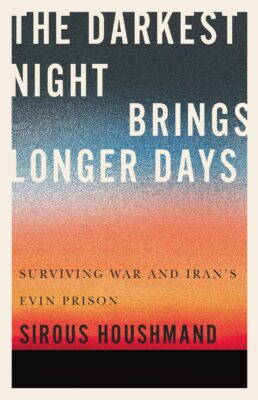
Surviving War and Iran’s Evin Prison
Sirous Houshmand
$24.95
paperback
234pp
9780228025771
Houshmand struggles to improve his sixth-grade level Farsi and reorient himself in the land of his birth, all while a new regime steps into power, and political uncertainty literally floods the streets with mass demonstrations. A string of life-changing events explode into the frame: helping save lives as a volunteer medic at the onset of the Iraq-Iran war, witnessing banal death and destruction befall his beloved people, and choosing between snitching or facing nearly certain execution along with thousands of other dissidents held in Iran’s Evin Prison, infamous for its human rights abuses against political prisoners.
Given the subtitle, I was expecting to learn about the horrors of prison life. The reader does get a sense of that in the last few chapters. However, Houshmand is less intrigued by the capacity of authoritarians to commit violence than by the will of individuals to resist. He frames the central question as follows: “why do some people stand up for their beliefs to the point of losing their lives? Is having a moral stance an act of becoming free or an expression of a utopian dream?” Houshmand’s quest is about unravelling the extraordinary circumstances, instincts, and insights that enabled him and his comrades to continue fighting for liberation.
Houshmand gestures toward the importance of the ongoing women’s liberation movement in Iran. At one point, he even affirms: “Over time, I realized that the key to liberating our region from despotism is through the emancipation of women.” However, the narrative fails to expand on this issue. He focuses more on the oppression of secular leftists such as himself by a conservative religious majority. Even then, Houshmand avoids diving into the political weeds, and vaguely aligns himself with the opposition’s struggle for “sovereignty, civil rights, and social and economic justice.”
At a time when authoritarianism is on the rise, Houshmand’s appeal to a universal human love of freedom and resilience is powerful. He grapples with a regime’s terrifyingly indiscriminate approach to doling out violence, noting that “[m]ost people around me were non-violent individuals whose only ‘crime’ was to hope for a different world.”
In each chapter, Houshmand offers a series of reflective questions. Their increasing complexity with each successive chapter mirrors his political development over time, building from naively rhetorical to philosophical and yielding no easy answers. Fascination and concern for how people make decisions in moments of crisis emerges from his unrelenting inquiry. At times, Houshmand’s tone can cross from genuine self-doubt into goading the presumed Western reader to question their own beliefs. At his best, he invites us to linger on his memories of deep ambivalence colliding with urgent, impossible demands – “before and after” moments, in which his very conscious experience of reality is never the same. This is a meditative journey guided by a man with an extraordinary life.mRb

I read the book and am amazed at how close the review came to my own conclusions.
Definitely a clear and well very written review.