



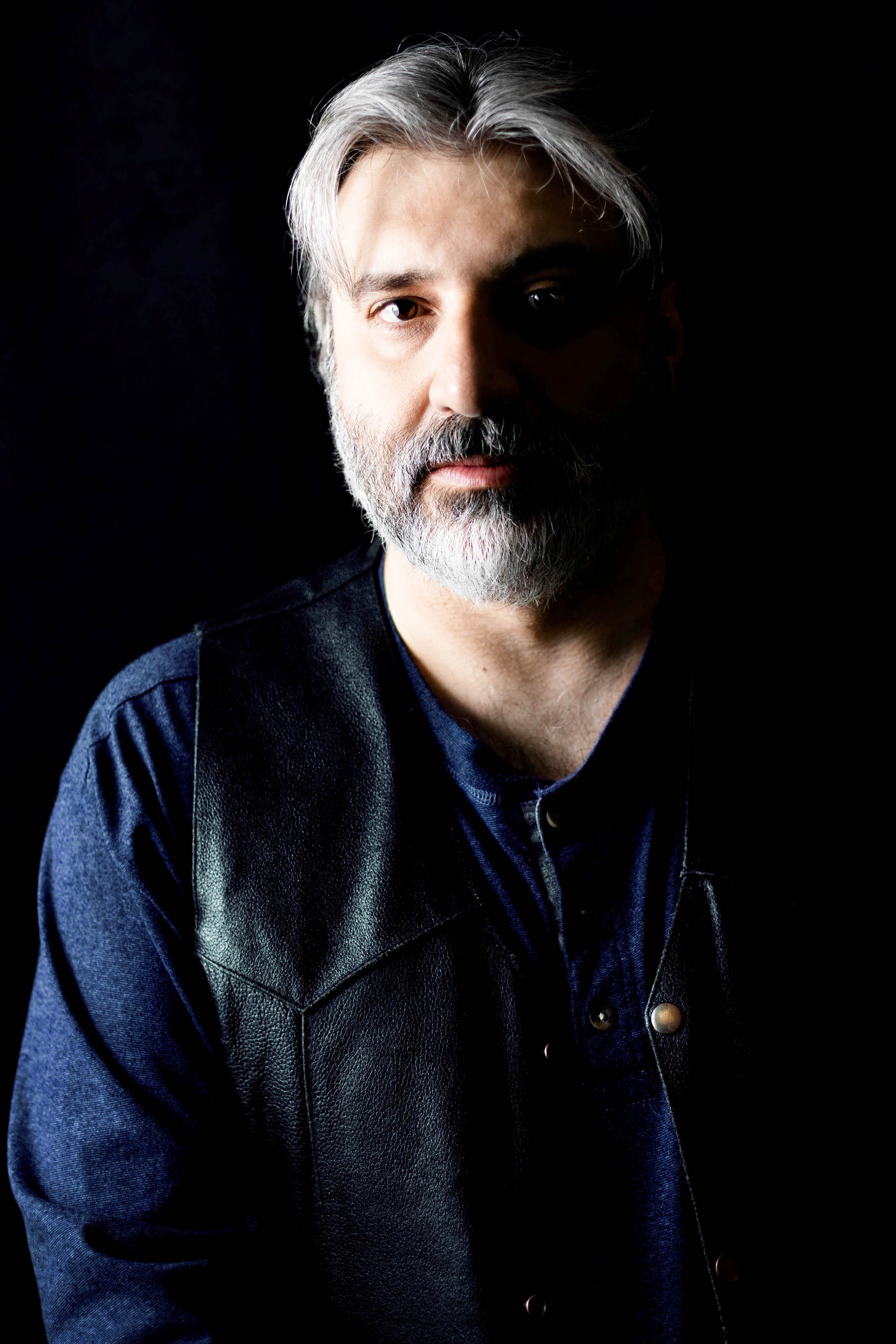
“I want to trouble the way we write history,” says Benjamin Libman. He is Zooming in from Paris, surrounded by books. “Not just the grand histories, but also the small histories of individual lives. What does it mean to write our own history, or, more troubling, to write the life of another into being?”
We’re discussing his book, The Third Solitude: A Memoir Against History. He’s on the young side to be writing a memoir, but this is not the story of a single life. It ranges across past and present, spanning continents, and is deeply rooted in generations of his family: Jews who fled Austria to escape the Holocaust. They came to Montreal and now their great-grandson is back in Europe – but he is still Montrealer enough to take the title of his book from Irving Layton, who added a third, Jewish solitude to those of Quebec’s English and French speakers.
The Layton quotation is, he says, “a provocation. The Jews were the third solitude in the sense that they were not welcome. These solitudes were structural categories, built into Canadian society writ large. Any peoples could inhabit them; they are about economic superiority and subordination, rather than cultural categories.”
“Jews typically performed working class or middle-class trades. Over time we accrued capital and we would own a shop; this is the history of the Main. As Jewish people in Canada rose, we forgot political solidarities that were part of our culture in Europe. We shook them off in order to rise economically. In our place, other people entered those positions. I wanted to highlight this transition that I think we’ve forgotten as a community. This history sits at the base of a lot of our institutions in Montreal.”
Are Montreal’s Jews still the third solitude? I ask Libman. “I don’t see us as that anymore, although in a sense we are that in the realm of memory.” That realm is the rich soil that feeds Libman’s thinking about the current moment. “This book originated with my great-grandmother Anna’s family documents I got on a trip to Vienna at the age of eighteen,” he says. Among those papers was a family photograph, a key reference point included early in the book, which shows a passenger train. Anna, her husband, and daughters look out of the train window; ten family members, sending them off, pose below on the platform. None of those ten will survive the war. Anna and her family fled Austria for Canada early, and were relatively established by the time postwar refugees began to land. Anna was a staunch Zionist, firmly believing in Israel as a safe haven for Jews. But she also devoted herself to helping Jewish refugees of all stripes, regardless of belief, including “assimilationists, socialists, and Communists whose ideas she claimed to abhor,” Libman writes. She and her husband helped these refugees immigrate, and found them shelter and employment. Anna inhabits the book as an animating spirit, a role model of Jewish comradeship beyond political divisions.
The Third Solitude Dundurn Press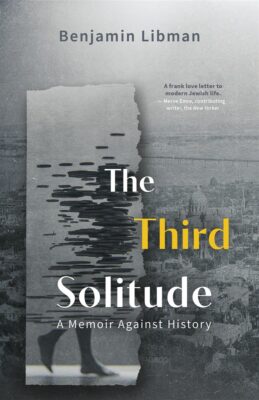
Benjamin Libman
$25.99
paper
208pp
paper
9781459753662
“Anna represents a different way of being a Jew. She came from a world – the Old World – in which being Jewish in a cultural sense meant a plurality of things, a lot of them contradictory. People my age, or even my parents’ generation, don’t realize that before the end of World War II, the vast majority of Jews on earth were either anti-Zionist or not in favor of Zionism. This was certainly true of Jews in Europe. It was also true of Jews in the Arab world, who had a multitude of deep, local identities tied to the places where they lived. They were not included in the original Zionist vision, which was designed for bourgeois Europeans.”
The five essays in The Third Solitude make for a dynamic whole. Opening with a familiar kind of Holocaust family history, the book moves on to explore the history of Zionism, the establishment of Israel, and how Montreal Jewish day schools inculcated students with Zionist values. One way is the March of the Living, a Zionist rite of passage for many North American teens. Sponsored by the Israeli government, it takes the teens to visit Auschwitz, followed by a pleasant vacation in Israel, all presented within the Zionist narrative of Jewish history.
“I am a bit antiauthoritarian regarding genre, so I used various forms in the different chapters – the travel essay, for example – to allow me to say what I wanted to say,” Libman explains. “I’m not saying I have my view, you have yours, let’s hold hands. I have strong views. I think Zionism is immoral. I don’t want us to agree to disagree, and I don’t want us to exclude people who disagree with us.”
The Third Solitude also discusses separatist ideology in Quebec, with these several threads drawn together in a beautiful, more obviously philosophical chapter on nostalgia and its uses for nationalism.
“Nostalgia is the object to look at most critically. It is a familiar and overwhelming emotion. Because it’s so powerful and foundational, we must be extremely skeptical of it. Nostalgia is not just something one feels, but something we utilize. You can see a movie and end up nostalgic for this fictive realm that it created. So much of our lives is governed by nostalgic views that other people have created and placed over our own like a veil. Israel and Quebec have done this – a vision of the past that governs our perceptions of the present. They make us feel the place we are in now has to be ‘made great again.’”
Libman seeks to recover Anna’s ethic of possibilities for “new ways of being individuals, Jews, and citizens,” as he writes. “I’m trying to recentre Anna in my conception of what Judaism can be. We need to find alternate futures,” he explains to me.
“The Zionist vision is that there was the past followed by the Holocaust and then the perpetually insecure present, which requires us to eliminate our enemies. It occludes many other kinds of Jewish futurity. A way to contest that, for example, is reacquainting us with other Jewish histories. A lot of Jews, especially non-Ashkenazi Jews, have these kinds of stories in their families, and these pasts need to be rediscovered. Then you uncover past ways of envisioning the future.
“I also believe in direct action, that wherever people find themselves situated in the social fabric, they do what they can to abandon Zionism as an ideology and open other spaces of consideration of what Jewishness could be. But there is no single program for getting us out of here. It requires a change in ethos. If we are going to have a healthy sense of futurity again, we need to give the breath of life to these alternative futures.” mRb

0 Comments