


It may be a good idea to ask yourself if you are ready to be fully immersed in the most difficult year of someone’s life when picking up a memoir titled Trying Unfathomably Hard to Live: Notes on the First Year of a Stroke. If the answer is yes, you’d best ask yourself if you would enjoy reading a text that is forthright, unvarnished, self-acknowledgedly diaristic and, because of these things, at times monotonous, but always self-aware.
Trying Unfathomably Hard to Live Sheer Spite Press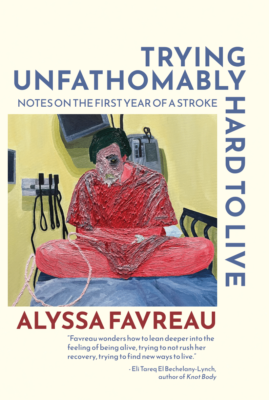
Notes on the First Year of a Stroke
Alyssa Favreau
$12-20
paperback
122pp
9781069450326
Short, with large font on small pages that seem to move through time slowly, this memoir does not exhibit unexpected twists, turns or edges. There is an honesty without eloquence that risks feeling underwritten, but is also revelatory about the difficulties of serious accidents, disability, and recovery. “This book is, literally, journaling that has gotten away from me,” writes Favreau. It is for the reader to decide whether they would like to read what are, as the subtitle promises, notes on the first year of a stroke.
Northern Girls Baraka Books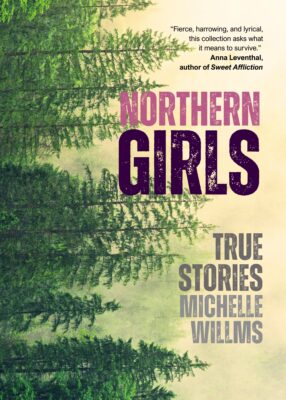
Michelle Willms
$21.95
paperback
136pp
9781771864091
Image and metaphor collide to produce an externalized interiority, described in sensory detail through descriptions of the formidable nature of the Canadian North. The heavier moments, which appear often, are written without disguise or timidity, but nor are they lingered upon; this may be why the reader can be immersed in such devastating circumstances without being entirely overwhelmed. Northern Girls tells its story with courage and tenderness, without shame or expectation, and in that, invites the reader to meet it where they are able.
Always unpretentious, yet lyrical and precise, the collection wanders from first-person recollections to second-person elegies written to people of the past; sometimes more confession, sometimes more apology, sometimes more epistolary in address. This loses effectiveness only when the cat, Britt, is introduced ambiguously in second person, at first seemingly a human girl. Generally, though, it brings an unmatched closeness and immediacy to an already unarmoured text.
A story that springs from a sensibility as deep as a frozen, northern lake, Northern Girls can be understood as a collection of experiences that have been lived in, suffered from, stayed with, survived, and finally metabolized into a path toward healing. Tough as nails and lightning fast at just over one hundred pages, it may be difficult not to read front to back in one sitting. Just do not let the speed lure you to forget the gift of true, piercing intimacy that it is.mRb


0 Comments