


The one-sentence stories in Mikhail Iossel’s new collection present us with the kind of risky stylistic experimentation – rare among established writers today – that could easily fall flat. In the hands of a less skilled author, this kind of writing might well be indigestible. But with Sentence, Iossel succeeds beautifully.
This is in large part due to the fact that, beneath the samizdat-influenced structures that hark back to his past as an underground Soviet writer, the stories are bursting with real heart, real melancholy, and real questioning from an acutely sensitive and perceptive soul.
Sentence Linda Leith Publishing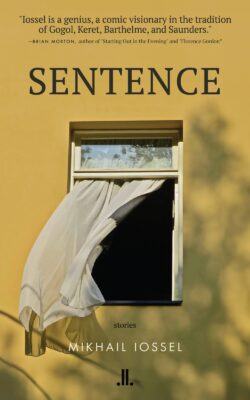
Mikhail Iossel
$24.95
paper
198pp
9781773901749
“Memory, I’ll submit to you, has no chronological dimension to it,” he writes in “Life Happened.” And Sentence is a reflection of this: a great swirling maelstrom of memory, in which bits of the past, ego, and identity float to the surface to be savoured and reconsidered. The effect, particularly in the longer pieces, is dizzying, intensely poetic, and oddly soothing. That they are written in a logorrheic torrent of run-ons, subordinate clauses, and parenthetical asides gives the stories a sense of urgency – and, paradoxically, an unrushed expansiveness.
This is dense writing that buoys you up and floats you through its ambience, unbothered by a certain degree of disorientation. Which is to say, it allows you to absorb a big-picture atmosphere – pleasantly foreign and internationalist – as opposed to requiring absolute dedication to every word. Considering that it is simultaneously granular in nature, this is an impressive trick; should you wish to zoom in, the components of these sentences are often as impactful as their overall effect.
The premise at the heart of many of the stories is simple: some event or image in the present triggers a memory from the past, which then snowballs into something unruly and overwhelming. Mirroring the émigrés’s life, we end up far from where we started. The Proustian madeleine, in this case, could be hearing Shostakovich’s Waltz #2 in the Montreal metro, leading to bittersweet recollections of a youth spent in Leningrad. Iossel delicately renders the minutiae of his childhood spaces and episodes, filling them with mentions of Armenian cognac, Estonian pralines, faraway Soviet cities, and faience teacups.
In “May 12: The Wolf,” Iossel the child overhears chilling snatches of conversation between pro-Stalin elders, who talk of “those heady no-nonsense old days of unbreakable national unity achieved through the stringent application of optimistic terror and general optimization of the warm brutality of fear …” There follows the sighting of an emaciated wolf prowling behind bars in the Leningrad zoo – a symbol, perhaps, of Russia’s eternally ravenous designs. It paints a gloomy but potent picture of the Soviet Union in its twilight phases, a “riddle wrapped in a mystery inside an enema.”
Iossel stuffs an impressive amount of poetry into his sentences, tossing off lines describing Russia’s “hopeless European aspirations and its shambolic Scythian existence,” or how Saint Petersburg’s “gossamer night, glowingly transparent, white-pinkish of hue, wore on lightly into the unworded endlessness of the day.”
Thematically, the stories often wrestle with language’s limitations in expressing the inexpressible. “Google Gulag” sees him considering “such a strange concatenation of sacrilegious alliterations,” and acknowledging the futility of attempting to convey the nature of Soviet terror to young students living in the comfort of a bourgeois society in 2025.
Whether he’s musing about growing up Jewish in the USSR or recalling a homeless man during COVID telling him, “There’s no cure for happiness, brother!” the everyday life-grist of Iossel’s writing mill is by turns moving, funny, transporting, and self-excoriating. Iossel gives us a masterclass in the purity of literary expression. One of the highest compliments I can give Sentence is that it should inspire young writers to take more risks, to write in a freer, more individualistic way. Be honest, be passionate, don’t be afraid to break the rules…. and your sentence will be well served. mRb

0 Comments