


Immersive as always, in Interposition, Kaie Kellough writes from inside the circuitry of contemporary life, tracing pressures exerted by capital, surveillance, digital mediation, and algorithmic systems on the body and imagination. The book-length poem probes into what it means to exist within technological infrastructures that have become so pervasive and ambient that they are nearly indistinguishable from reality itself.
Interposition McClelland & Stewart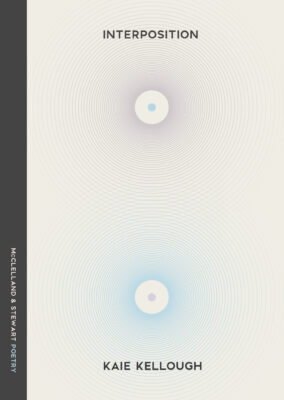
Kaie Kellough
$25.00
paperback
112pp
9780771023729
In Kellough’s long poem, the body becomes increasingly financialized and abstracted, folded into speculative systems of value and surveillance. One especially striking passage imagines the speaker
curled inside a financial product tucked
inside a surveillance drone hoping to gain
the long view of decimal points, a few timbits, loose grains
of splenda to suck off in my retirement
back back back.
In surprising and twisting ways throughout, Kellough deftly suggests that the violences underpinning twenty-first century digital culture are extensions and mutations of older structures of domination, racism, and dispossession still humming beneath what Kellough calls the “white noise machine” of the present.
The form of this poem, any poem, cannot rescue the reader from the structural burdens of daily life, but Kellough suggests that poetic work itself might function as disruption: “my job is to undo … / a subsonic fissure thru the infrastructure.” The line encapsulates the poem’s larger project, one that cannot escape from technological capitalism entirely, but can still expose the fractures already vibrating within it.mRb



0 Comments