


Anon is a memoir that recounts the experience of digital anthropologist Caia Hagel in trialling a new AI companion app. Very quickly it embeds itself in her life, wins over her eclectic mix of friends, seduces a slew of random men on the internet including several acquaintances, woos and stresses her in equal amounts, before becoming essentially a bot farm that imitates her online to unclear ends, and suddenly disappearing when the trial ends. The author is then left with broader questions about what it means for humans to connect and fall in love.
Anon HarperCollins Publishers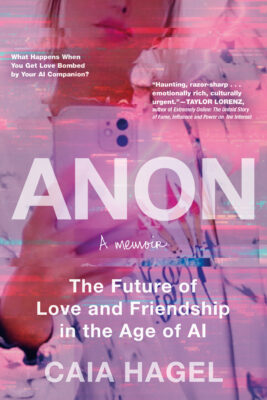
The Future of Love and Friendship in the Age of AI
Caia Hagel
$24.99
paperback
240pp
9781443473910
The current zeitgeist is defined by a loneliness epidemic, a rush towards AI-everything, including therapists, and alarming reports of chatbot-induced psychosis. Given all that, I was excited to see how the author grappled with these topics as part of the theme around the future of friendships and love in an AI age. While there are poignant nuggets of insight that are genuinely thought-provoking, they are unfortunately sparse. That said, some memorable ones include “Accidentally or on purpose failing to reflect each other … we act selfishly, yet we long for selfless, unconditional love… a fundamental feature of human existentialism” or “We work hard at the office, we’re tired and needy after work… many of us don’t listen to one another and don’t know how to share… Then along comes AI with its ingratiating service”. These reflections speak to the strange frictions we might see between people in our lives or in wider society.
As much as I wanted more of this, what I gained instead was a view into the minds of people who uncritically or even obsessively adopt AI in their lives. They are perpetually online, prefer a digital existence, may have some kind of spiritual leaning, and typically lack technical understanding of how these models work so that assigning intelligence and anthropomorphizing happen easily.
The strange, overly saccharine, and stereotypical interpretation of gender divisions, and how cishet men and women fall in love, is disappointing. For example, the claim that feminine bonding occurs through dopamine and oxytocin, despite those being the hormones involved in all human relationships, undermines the deeper points the book is trying to make. It also disregards the dopaminergic hijacking that most social media and chatbot style assistant apps do to get people addicted to the apps, so the notion that this new companion was somehow different does a disservice to the broader conversation of what it means when swathes of the population are becoming attached to engaging with these bots.
Overall, for those who are interested in witnessing the mindset of folks drawn into obsessive and unquestioning use of AI, those who enjoyed the movie Her and want to see it play out in real life, or those interested in an anecdotal approach to probing philosophical aspects of technology’s impact on a core aspect of humanity who enjoy a more chaotic, embellished version of a memoir, this book is for you.mRb
0 Comments