


Montreal-based photographers share observations and memories in the city in two recently released photobooks. Through vernacular objects, Dean Garlick explores the materiality of his everyday surroundings. G. Scott MacLeod documents events from a musical era that was fuelled by social and political engagement.
100 Sculptural Circumstances Self-published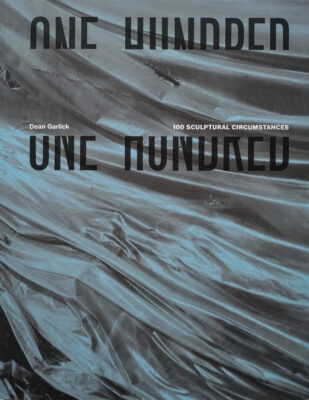
Dean Garlick
$30
paperback
112pp
9780993714122
Throughout the book, viewers are invited to take a closer look at the urban environment. Chance encounters might not seem to belong together at first, but they pair well thanks to Garlick’s curation: tessellating bricks (sometimes askew), wood planks, and aging pipes arranged in satisfying order, and pops of colour from construction debris, to name a few instances. Sometimes it’s unclear if the subject matter is a wall or a floor until you realize which direction gravity is pulling in. Yard chairs, just barely visible beneath overgrown weeds, are juxtaposed with the same chairs covered in dormant and bare vines on the adjacent page. Snow is visible in one photo, but the ground is grassy in the next. Garlick plays with a temporal ambiguity that might feel familiar to anyone who has lived through Montreal’s temperamental seasons. His selected photographs articulate the focus of his work: “the city and its constant state of transformation.”
Garlick “challenges the viewer to be fascinated by the world, and invites them into the embrace of the alchemy of the mundane.” By noticing what’s often overlooked, these 100 sculptural circumstances are aesthetically satisfying while also celebrating all the stuff left around a city that’s constantly working on itself.
Human Rights in the Rhythm of Rock Self-published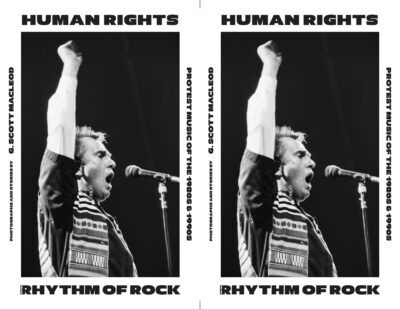
Protest Music of the 1980s & 1990s
G. Scott MacLeod
$40
paperback
80pp
9781990402098
MacLeod delivers a nostalgic portrait of a time he perceives as more idealistic and politically active than today’s mainstream pop music. At age sixty, he looks back at the “poetic, political, and historical spirit” of a period in his life when he “was witness to some meaningful performances” with his valued press pass in hand. Film grain, paired with accompanying text that details his memories of being a young photographer, layer onto his romanticization.
As much as it was in the eighties and nineties as it is now, music is central to Montreal’s spirit. Music has the power to unite us against oppression when it is harnessed as a tool of protest. Inspiring solidarity is crucial as we face human rights crises ongoing around the world, such as the atrocities in Palestine, Iran, and Lebanon. With MacLeod’s foreword expressing hope that today’s youth will create a better world than his generation could, Human Rights in the Rhythm of Rock is a timely reminder that art carries political weight, and that we have a responsibility to act on it.mRb

0 Comments