

“We are exhausted. We are overwhelmed. Worse, we are numb,” proclaims author Mark Abley in his book of the same name. Medically speaking, numbness is not often a natural state. Medical sources describe it as a “loss” — of feeling or sensation, a symptom of a larger problem. Feeling numb, in a metaphorical sense, is also often the result of some outside force, something larger that piles up day after day, week after week.
Numb Baraka Books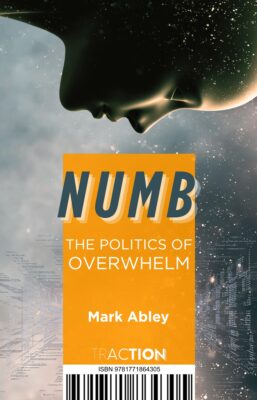
The Politics of Overwhelm
Mark Abley
$16.95
paperback
114pp
9781771864305
Acknowledging our deteriorating attention spans throughout the book, Abley does us a service by keeping his thesis to around ninety pages. Yes, Numb is more thesis than manifesto, though the question of genre ties into one of its shortcomings: it attempts to define an inherently subjective and personal phenomenon. Abley wishes to pin down this unique malaise he (and others) experiences, but in doing so he forgets to take a step back, to see the forest from the trees. He is trying desperately to make sense of these four crises. Many will agree that two humanitarian disasters, an impending ecological collapse, and a rogue U.S. president have worn away at us, day in and day out. But aren’t there other subjects that would drive a news reader to despair? We hardly are reminded about the over seven million lives lost to COVID-19, the staggering levels of overdose deaths, or the structural and everyday racism facing BIPOC individuals and communities across Canada.
Beyond Numb’s four cornerstones of despair, hope does seep through the cracks. A recurring figure of said hope is the late naturalist Jane Goodall, who Abley returns to often as someone who refused despair and numbness, who always chose to feel alive and hopeful. On top of another throughline of animal compassion, not to be spoiled in this review, Goodall’s commitment to hope speaks volumes to how we meet the present moment, and how we can, in fact, reconnect with the richest experiences of humanity.
Perhaps this is the greatest contribution of Numb. We can control ourselves. We can respond to and resist the maelstrom of violence and bigotry that drives so many of us to despair. One of the simplest ways to do this: read. Not just the news, but whole books. If mainstream media normalizes genocide and climate catastrophe right before our eyes, let’s counter the prevailing trend and take literacy into our own hands. If the persistence of this very publication is proof of anything, it is that as readers, we have power. If we see broadcasters trivializing catastrophes as everyday occurrences, we must renew our own media literacy and call out poor journalism to retain our sanity, and our hope. And if certain crises seem too overwhelming to read about, we must find ways to talk about and respond to them that honour loss and suffering without sacrificing the privilege of political action.
Abley’s slim thesis may not be the manifesto it aspired to, but rather a testament to the hallmark fatigue built up over the last few years of headlines. Numb does not articulate a clearly structured politics, as its full title suggests. It scratches the surface of a new media landscape that floods the zone and fractures its audience with politics meant to overwhelm, not inform. But the feeling of overwhelm is just that: a feeling. Though one we, as a society, desperately need new tools to overcome.mRb
0 Comments